

In short, a septic tank is a buried tank that partly treats a home’s waste water where there is no mains sewer. Solids sink to form sludge, fats float as scum, and the settled liquid runs out to a drainage field, where the soil completes the treatment. The tank only does the first part of the job. The ground does the rest, which is why the drainage field matters as much as the tank itself.
This guide follows the waste water from the house to the soil, explains the parts a contractor may mention, and sets out what the official guidance says in each UK nation. If something is already wrong, such as sewage backing up or a wet patch in the garden, you can find a listed contractor now and come back to the detail later.
What is a septic tank?
A septic tank is a buried tank that holds back the solids in a home’s waste water and passes the liquid on for further treatment.
GOV.UK describes it as an underground tank where the solids sink to the bottom, forming a sludge, while the waste water goes on to a drainage field. The building guidance used in England and Wales, Approved Document H, says the tank provides the conditions for solids to settle, be stored and partly decompose, but that the liquid leaving it can still be harmful and needs further treatment. So a septic tank never works on its own. It is one half of a system, and the drainage field, or another form of secondary treatment, is the other half.
Approved Document H says systems like this should only be considered where connecting to mains drainage is not practicable. You may hear the whole arrangement called off-mains drainage, a septic system or a private sewage system. Factory-made tanks are made from glass reinforced plastic, polyethylene or steel, and tanks can also be built in brickwork or concrete. Either way, the tank has to be watertight, so that sewage cannot leak out and groundwater cannot get in.
How does a septic tank work, step by step?
Solids settle and stay in the tank, where they partly break down. The liquid flows to a drainage field, and the soil completes the job.
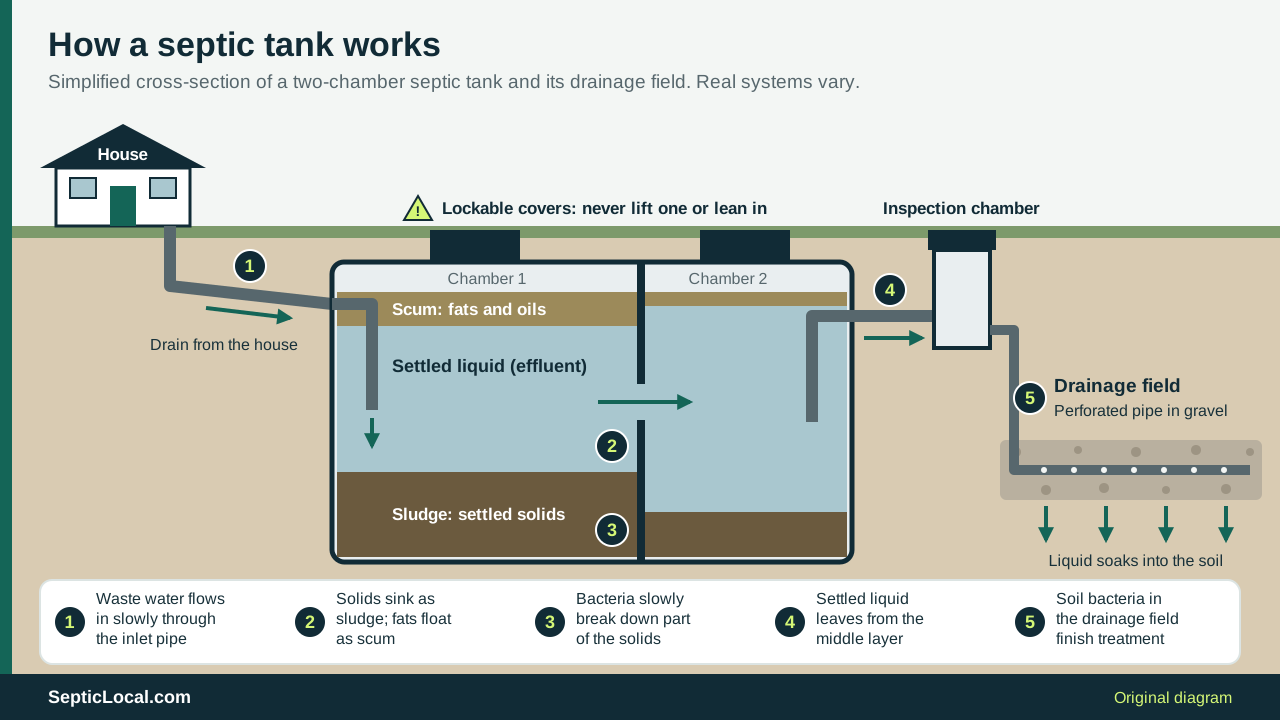
The numbers below match the diagram at the top of this guide.
- Waste water arrives. Everything from the toilets, sinks, bath, shower and washing machine runs through the house drains into the first chamber. Approved Document H asks for the incoming flow to be slowed, for example by laying the last 12 metres of a steep drain at a gradient of 1 in 50 or flatter. In tanks up to 1,200 millimetres wide, the inlet should be a dip pipe, which releases the water below the surface. Calm water gives the solids a chance to settle.
- The waste separates into layers. Heavier solids sink to the floor of the tank as sludge. Fats, oils and lighter material float to the top as a layer of scum. Between them is a layer of settled liquid, called effluent.
- Bacteria break down part of the solids. Bacteria already present in the sewage slowly break down some of the sludge. The tank has no air pump, so this treatment is slow and only partial, and the rest of the sludge builds up until the tank is emptied.
- The liquid moves through the tank and out. Approved Document H asks for at least two chambers or compartments working in series, with an inlet and outlet designed so they do not disturb the scum or the settled sludge. The liquid passes into the second chamber, settles again and leaves through the outlet pipe, normally passing an inspection chamber on its way to the drainage field.
- The soil completes the job. In the drainage field, the liquid runs along pipes with small holes, bedded in gravel, and spreads out through the ground. Approved Document H says biological treatment takes place naturally in the aerated layers of the soil. NetRegs, the environmental guidance service for Scotland and Northern Ireland, adds that soil bacteria break the liquid down further and plants take up the nutrients.
Nothing in this process gets rid of the sludge. It stays in the tank until a tanker takes it away, which is why every septic tank needs emptying. Our septic tank emptying page lists businesses that do this work.
What are the sludge and scum layers?
Sludge is the layer of heavy solids on the tank floor. Scum is the floating crust of fats, oils and light material on top.
The layers show the tank doing its job, but they take up space. As they grow, there is less room in the middle for the liquid to sit still and settle. GOV.UK says that in England sludge has to come out before it goes over the most the system can hold. Natural Resources Wales says both the sludge and the scum need removing from time to time, and that a registered waste carrier must take them away for disposal.
What you put down the drains changes the layers. Natural Resources Wales says to flush only human waste and toilet paper, and not to pour oils, chemicals, fats or solvents into the drains. SEPA gives similar advice for Scotland: no grease, oil or chemicals, and nothing that does not biodegrade. Our guide to what is safe to put in a septic tank covers everyday products, from cleaners to dishwasher tablets.
You cannot judge the layers from the garden, and you should never lift a cover to look. Leave any measurement of the sludge to the business that empties or services the tank.
Where does the liquid go after it leaves the tank?
It flows on to a drainage field: pipes with holes in gravel-filled trenches that let it seep into the ground for the soil to treat.
GOV.UK defines a drainage field, also known as an infiltration system, as a series of pipes with holes placed in trenches, arranged so the waste water can trickle through the ground for further treatment. Many people call it a soakaway, and NetRegs uses that word too. In England, though, GOV.UK says you cannot meet the general binding rules by sending septic tank effluent to a soakaway designed for rainwater if that soakaway was installed after December 2007.
The ground has to suit the job. NetRegs says well-drained soil with more than 2 metres of soil above the water table is the best option. Under Approved Document H, drainage field disposal is only for sites where percolation tests give an average result, known as Vp, of between 12 and 100. Vp is the average number of seconds the water in a test hole takes to drop by 1 millimetre. Where the subsoil is sometimes waterlogged, a drainage mound, which is a drainage field built above the natural ground level, may be used instead. Where no ground on the site is suitable, NetRegs says the liquid needs further treatment, such as a package treatment plant or reed bed, before it can go to a watercourse.
England has a firm rule here. GOV.UK says you must not discharge effluent from a septic tank to a watercourse. Where an existing tank does, the owner has three options: a public foul sewer connection, a small treatment plant in place of the septic tank, or a drainage field that meets the rules for discharges to ground. The work should happen within a reasonable timescale, which GOV.UK says is usually 12 months. In Wales, Natural Resources Wales says that if the discharge goes to surface water, you must use a package treatment plant.
To have a drainage field assessed, tested or replaced, see our drainage field services page, which also covers percolation tests and the usual distances from buildings and water supplies.
What changed for drainage fields in England in July 2026?
On 23 July 2026, GOV.UK added conditions under which a discharge to ground engineered to slow its percolation rate can meet England’s general binding rules.
The GOV.UK page on small sewage discharges to the ground was last updated on 23 July 2026, with the change note “Added the requirements for discharges to ground which has been engineered to reduce the percolation rate”. It now says these discharges can meet the general binding rules if:
- they are not in a floodplain
- the engineered ground has a minimum percolation value (Vp) of 15
- they are located, designed and constructed in line with all the other recommendations in British Standard BS 6297:2007
In plain terms, this is about ground that drains too quickly. A low Vp means the water disappears fast, and Approved Document H explains that its minimum value is there so untreated effluent cannot percolate too rapidly into groundwater. Engineering the ground slows the flow, giving the soil time to treat the liquid. If an installer proposes this for a property in England, ask to see the percolation results for the engineered ground and how the design follows BS 6297:2007. Drainage mounds already had their own conditions on the same page: not in a floodplain, and built in line with BS 6297:2007. The change applies to England only.
Does a septic tank need electricity?
A standard septic tank needs no electricity: waste water flows through it by gravity. Power is needed only for a pump or a treatment plant.
Some sites do need a pump. NetRegs notes that a drainage mound may need a pump to lift the waste water into it. If your system has a pump, an alarm or any other electrical equipment, that equipment needs looking after too. GOV.UK lists a failed motor, a failed pump and a failed electrical supply among the faults that mean a system in England needs repairing or replacing. Requirement H2 of the Building Regulations, explained in Approved Document H, also says a system must, where relevant, keep working well enough to protect health if the power fails.
If your system has an air pump or a control panel, it is likely to be a sewage treatment plant, not a septic tank. Approved Document H describes packaged treatment plants as engineered systems that treat effluent to a higher standard than septic tanks. Our treatment plant air pump guide covers common faults, and treatment plant servicing lists businesses that service them.
How big should a septic tank be?
In England and Wales, new septic tanks should hold at least 2,700 litres for up to four users, plus 180 litres for each extra user.
The figure comes from paragraph 1.18 of Approved Document H. England and Wales each publish their own version of the document, and both give the same minimum. The capacity is measured below the inlet level, so it is the working volume of the tank, not its outside size. The guidance sets a capacity rather than dimensions, so two tanks with the same capacity can be quite different shapes.
| Number of users | How it is worked out | Minimum capacity below the inlet |
|---|---|---|
| Up to 4 | Base figure | 2,700 litres (2.7 m³) |
| 5 | 2,700 + 180 | 2,880 litres |
| 6 | 2,700 + (2 × 180) | 3,060 litres |
| 7 | 2,700 + (3 × 180) | 3,240 litres |
| 8 | 2,700 + (4 × 180) | 3,420 litres |
A worked example: a household of six needs at least 2,700 litres for the first four users plus 2 × 180 litres for the other two, which comes to 3,060 litres. That is a minimum for a new tank, not a target. An installer will also consider how the property is used, the ground and what the regulator needs, and in England a new discharge needs building regulations and planning approval. Ask how many users the design assumes, and why.
Approved Document H also gives siting guidance for new tanks in England and Wales: at least 7 metres from any habitable part of a building, preferably downslope, and within 30 metres of vehicle access where a tanker will empty it, provided the tank’s invert level is no more than 3 metres below that access.
Scotland and Northern Ireland set their own standards. Scotland’s building standards technical handbook for homes (April 2026 edition, standard 3.8) says every part of the tank should be at least 5 metres from a dwelling and from a boundary, and that the desludging tanker needs a working area no more than 25 metres from the tank. For sizing, it points designers to the British Water code of practice Flows and Loads 2. In Northern Ireland, regulation 83 of the Building Regulations (Northern Ireland) 2012 says a septic tank must never have a capacity of less than 2.7 cubic metres.
Finding the size of an existing tank
Start with the paperwork: the installation records, building control approval, past emptying invoices or any survey report. An emptying invoice may record the volume removed, which gives a rough guide. If none of these exist, ask a contractor or surveyor to establish the size. A survey can confirm the size, type and condition of the tank at the same visit, which is worth doing before you buy a property that uses one. See septic tank surveys and our guide to buying a house with a septic tank.
How is a septic tank different from a cesspit or a treatment plant?
A cesspit only stores sewage. A septic tank settles it and relies on the soil. A treatment plant treats it to a higher standard.
Approved Document H describes a cesspool, the formal name for a cesspit, as a watertight underground tank for storing sewage, with no treatment involved. Because nothing leaves it, it fills and must be emptied far more often than a septic tank. Packaged treatment plants treat effluent to a higher standard than septic tanks, which normally allows the treated water to go straight to a watercourse. Our starting guide to tank types has a side-by-side table, and the cesspit emptying and sewage treatment plant installation pages list businesses for each.
What rules apply in England, Wales, Scotland and Northern Ireland?
England follows the general binding rules, Wales needs registration with NRW, Scotland needs SEPA authorisation and Northern Ireland needs a discharge consent from NIEA.
GOV.UK’s overview of septic tank rules applies to England and points to separate rules for the other three nations. The table summarises what each regulator’s own pages said when we checked them on 27 October 2026. It is a starting point, not legal advice. The detail depends on the site, the age of the system and where it discharges, so check the page for your nation and ask a qualified installer before you change anything.
| Nation | Regulator | What a household septic tank needs | Emptying guidance |
|---|---|---|---|
| England | Environment Agency (GOV.UK) | Meet the general binding rules or hold a permit. A discharge to ground must go through a drainage field and be no more than 2 cubic metres (2,000 litres) a day. Septic tank effluent must not go to a watercourse. | At least yearly, or as the manufacturer instructs. The sludge must go to a registered waste carrier. |
| Wales | Natural Resources Wales | Registration, which in most cases is a free one-off. The conditions include a discharge under 2,000 litres a day to a drainage field, or under 5,000 litres a day to a watercourse, which must come from a package treatment plant. | Every 12 to 24 months by a registered contractor. Keep records for 5 years. |
| Scotland | SEPA | An authorisation to discharge if a public sewer connection is not possible. Discharges from up to 10 homes can usually be registered; the fee shown was £198.55 (SEPA does not mention VAT). A permit is needed to discharge to a phosphate sensitive catchment or a freshwater loch. | At least once a year. |
| Northern Ireland | Northern Ireland Environment Agency (DAERA) | A discharge consent under the Water (Northern Ireland) Order 1999. Discharge to ground must be explored first; a waterway is considered only where that cannot be achieved. | Not set out on the DAERA page. Our emptying guide covers the options. |
In England, the general binding rules also say that anyone who maintains the system must be competent and that, on a sale, the new owner must be told in writing about it, describing the system, where its main parts are, any changes made and the maintenance records. A discharge point in a groundwater source protection zone 1 generally needs a permit. Some conditions depend on when the discharge started, with extra rules for discharges from 1 January 2015 and from 2 October 2023.
In Wales, the conditions for free registration include keeping a drainage field out of a groundwater source protection zone 1, at least 50 metres from a well, spring or borehole that supplies water, and at least 50 metres from protected sites. In Scotland, SEPA’s registration guidance asks for soil percolation test results where the discharge goes to land, and the Scottish technical handbook says a discharge to a watercourse, loch or coastal waters may be possible where the ground is unsuitable. In Northern Ireland, DAERA says the consent applies to homes without a public sewer connection.
What stops a septic tank working?
Usually one of four things: overdue emptying, the wrong things down the drains, damaged pipes or tank, or a drainage field that cannot absorb water.
Each part of the system fails in its own way, and the symptoms overlap. GOV.UK lists the faults that mean a system in England needs repair or replacement, including leaks, cracks in tank walls or pipes, blocked pipes, pools of water around the drainage point and sewage smells. The table links each part of the system to the problems the official guidance mentions and the kind of help that fits.
| Part of the system | What can go wrong | Where to start |
|---|---|---|
| Drain from the house | A blocked or broken pipe | Septic tank repairs |
| Tank contents | Sludge and scum left too long, filling the space the liquid needs to settle | Septic tank emptying |
| Tank structure | Leaks or cracks in the tank walls | Our leaking septic tank guide |
| What goes in | Fats, oils, chemicals or solvents, or roof water connected to the system | Our guide to safe products |
| Drainage field | Waterlogged or blocked ground, with water pooling near the drainage point | Drainage field services |
| Ground above the field | Parking or paving over the drainage area, or trees planted close by | A septic tank survey |
Natural Resources Wales notes that drainage fields can become blocked after several years even when the system is well maintained, and may need replacing. Timing is a useful clue for a contractor: if symptoms return shortly after an empty, the cause may lie in the pipework or the drainage field rather than the tank. Our guide to the signs your septic tank is full sets out the symptoms in more detail.
How often does a septic tank need emptying?
GOV.UK advises emptying at least yearly in England, or as the manufacturer instructs. In Wales, NRW advises every 12 to 24 months.
SEPA advises emptying or desludging at least once a year in Scotland. In England and Wales, the business that takes the sludge away must be a registered waste carrier. Our guide to emptying intervals turns this into a plan for your household, and the emptying cost guide sets out what affects the price.
Common questions
Should I check my septic tank myself?
Never climb in or lean over an open tank. Guidance suggests regular outlet checks, so ask a contractor how to do them safely.
Approved Document H includes an example maintenance notice for England and Wales that mentions monthly checks that the effluent in the outlet chamber or distribution box is free flowing and clear, and Scotland’s technical handbook also suggests monthly checks. Approved Document H also says tank access should be lockable or otherwise made to stop people getting in. Ask the business that maintains your system to show you a way to check the outlet without putting yourself at risk, or to include it in each service. The simplest safe check is the ground: Natural Resources Wales suggests looking at the drainage field every month for waterlogging.
Can rainwater go into a septic tank?
It should not. Natural Resources Wales says not to connect roof or surface water run-off to a septic tank system.
Rain from roofs, paths and drives needs its own drainage. If you are not sure where your gutters and yard drains go, ask a drainage contractor to trace them before you assume the septic tank is at fault.
Can I build or park over the drainage field?
No. Building guidance keeps driveways and paving off the drainage field, and Natural Resources Wales advises against parking on it or compacting it.
Approved Document H, paragraph 1.30, says no access roads, driveways or paved areas should be located within the disposal area. Natural Resources Wales also advises against planting trees near the system. If you are planning an extension, a patio or a new drive, find out exactly where the tank and the field are first.
Do additives or bacteria products help a septic tank work?
No official guidance we checked asks owners to add products. It asks for regular emptying, maintenance and care over what goes down the drains.
The bacteria a septic tank relies on are already present in household sewage. Before you buy a treatment, read our guide to treatments and additives.
Sources and further reading
Checked 27 October 2026. Official guidance is revised now and then, so read the current page for your nation before acting.
- GOV.UK: general binding rules, small sewage discharge to the ground (England, updated 23 July 2026)
- GOV.UK: general binding rules, small sewage discharge to a surface water (England)
- GOV.UK: septic tanks and sewage treatment plants, what you need to do (England, with links for the other nations)
- GOV.UK: Approved Document H for England, 2015 edition (PDF)
- Welsh Government: Approved Document H for Wales
- Natural Resources Wales: how to register a household sewage system
- Natural Resources Wales: running and maintaining your system
- SEPA: septic tanks and private sewage treatment systems (Scotland)
- SEPA: maintaining your private sewage treatment system
- Scottish Government: building standards technical handbook, domestic, April 2026 (standard 3.8)
- DAERA: regulating water discharges (Northern Ireland)
- legislation.gov.uk: Building Regulations (Northern Ireland) 2012, regulation 83
- NetRegs: how septic tanks work (Scotland and Northern Ireland)
- HSE: introduction to working in confined spaces
Find help with your septic tank
Search the listed contractors, then check that the one you choose covers your postcode and your type of system, or browse locations to see which businesses list your area. For a routine empty, start with septic tank emptying. For a wet garden or a system that keeps backing up, start with drainage fields. Septic Local lists independent businesses. We do not empty, survey or repair tanks ourselves, and we are not an emergency service.
Ready to book? Get a quote
Tell us about the job and we will pass it to one listed contractor that covers your postcode and does this work. It is free, and you agree the price and visit directly with the business. Prefer to choose yourself? Call any business on this page.