

Septic tank emptying costs depend on the job and the provider. A useful price needs to say how much waste will be removed, how the tanker can reach your tank and whether the visit includes anything beyond pumping and disposal. A headline figure without those details can be difficult to compare.
This guide explains published examples checked on 19 October 2026, the questions behind a quote and how to budget for repeat visits. The figures are examples of particular services, not a national average or a quote from Septic Local. To contact businesses advertising the service, use our septic tank emptying directory.
Published emptying prices: what the examples actually cover
Public prices can help you judge a quotation, provided you keep the service conditions attached. The following examples come directly from the organisations offering the service. Availability and charges can change after the review date.
| Provider and service | Published figure | Important qualification |
|---|---|---|
| ATAC Solutions: septic tank and cesspit emptying | From £257 | A starting price for its service area. The final quote depends on volume, access, location and the work required. Provider source. |
| Scottish Water: scheduled septic tank desludging, 2026-27 | £254.40 | A specific scheduled-service tariff, subject to Scottish Water’s conditions. It is not a general Scottish market price. Tariff source. |
| NI Water: qualifying domestic desludging service | One free discretionary service in a twelve-month period | Service conditions apply, including access and the scope of sludge removal. Additional requests may be charged. Service source. |
These services are not identical. Check the provider’s current terms before treating one as a cheaper alternative to another. A Scottish Water tariff or NI Water entitlement should not be used to predict a private contractor’s price elsewhere in the UK.
What changes a septic tank emptying quote?
Volume included
Ask whether the quotation covers a stated number of litres, a tanker load or the complete agreed job. A tank’s nominal capacity and the quantity actually removed are different figures. If your records are incomplete, explain that at booking and ask how the business will handle an uncertain volume. Obtain the rate for any extra quantity before the visit.
Tanker access and hose reach
A business needs to assess where its vehicle can safely park and how its hose can reach the access point. Describe narrow lanes, sharp bends, locked gates, steep slopes and soft ground. Tell the contractor if the route crosses another property. Do not guess that the largest vehicle can use a driveway because a delivery van managed it.
The actual service requested
Scheduled sludge removal, a blockage investigation and a treatment-plant service are different jobs. If your main concern is an alarm, recurring flooding or a suspected leak, say that when you request the quote. A low pumping price may not include diagnosis, replacement components, a camera survey or a written condition report.
Timing and additional visits
Ask about the difference between a planned visit and an urgent call-out. Confirm whether a return trip, unsuccessful access or extra equipment would create another charge. A realistic quotation should explain the circumstances that can change the total rather than leaving you to discover them after arrival.
Ask for the total, then check the exclusions
Start with a simple request: “What is the total payable for the service described, and what could make it increase?” Ask the provider to confirm the tax treatment and any applicable VAT in writing. Do not add a blanket percentage yourself: different services within the same visit can have different treatment.
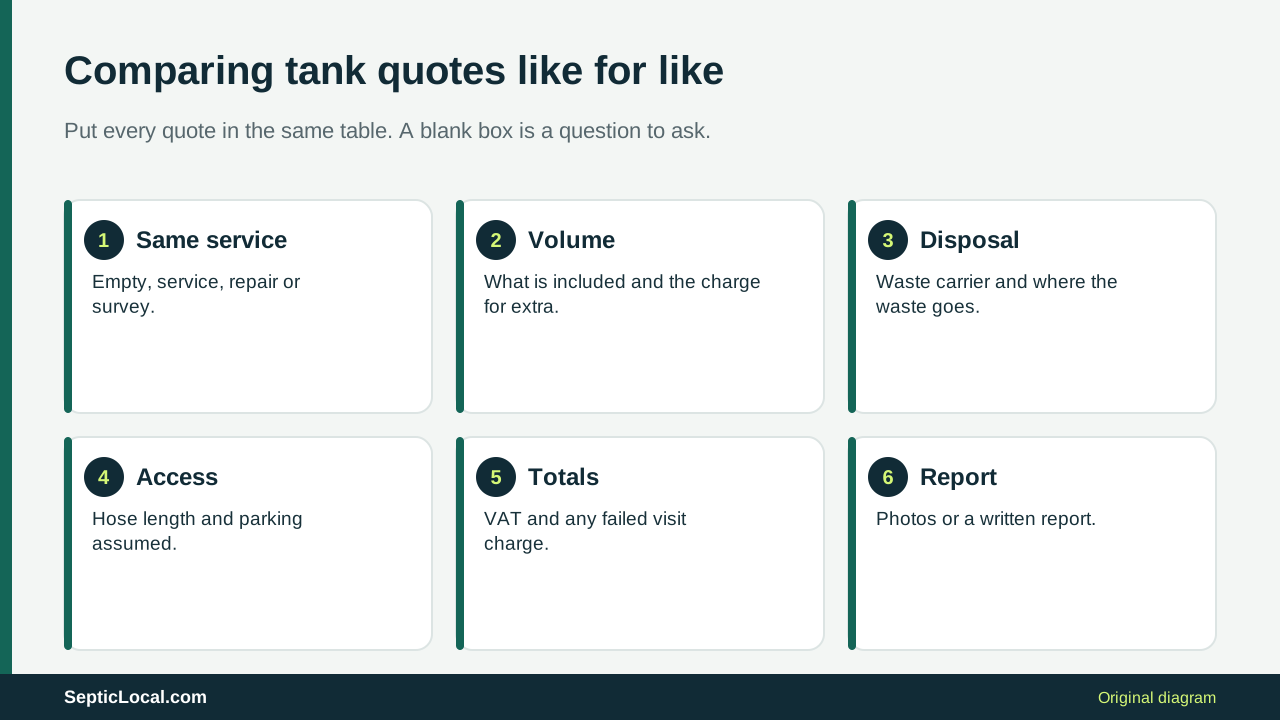
Use this scope checklist alongside the provider’s quotation:
- The system type and property address the quotation relates to.
- The amount of waste included and the basis for extra-volume charges.
- Whether transport, waste treatment and disposal are included.
- Whether the price assumes particular vehicle access or hose reach.
- Any inspection, service report or additional maintenance included.
- Urgent-visit, cancellation, waiting-time or aborted-visit charges.
- How extra work will be priced and authorised.
Keep the email or written quotation with your booking confirmation. Our existing guide to comparing tank quotes offers a wider comparison checklist. This page focuses on the cost of emptying and the assumptions behind it.
Why cesspit emptying costs are a different calculation
Confirm which system you have before estimating the running cost. A cesspit stores sewage for removal, while a septic tank allows treated liquid to leave through its discharge arrangement. A treatment plant has its own servicing and desludging requirements. The everyday use of “septic tank” for all three can lead to a quotation for the wrong service.
For a holding tank, the cost of a single collection is only part of the budget. Ask the operator to explain the usable storage, the expected collection arrangements and how you should respond to a high-level alarm. Do not apply a septic tank’s sludge-removal timetable to a cesspit. If you are unsure, read our existing guide to identifying your system and ask a contractor to confirm it from records and a suitable assessment.
How to build a useful annual budget
Use the actual quoted price and the maintenance schedule recommended for your system. Multiply the agreed routine visit charge by the number of planned visits, then list any separately quoted servicing. Keep repair work outside that routine figure so you can see which costs are predictable and which depend on a fault.
For example, if your written quotation is £280 for one planned visit, £280 is the starting annual allowance for that one visit. This is an arithmetic illustration, not a market price. If a second visit is recommended, ask for that price rather than assuming it will be identical. Access requirements or a different service scope could change it.
Record the date, quantity removed and invoice reference after each appointment. If the need for visits changes unexpectedly, ask why before simply increasing the budget. A change in use may explain it, but a continuing drainage problem needs assessment. Read how to plan an emptying schedule for the distinction between routine maintenance and an emerging fault.
Ways to avoid avoidable costs
Good preparation is more useful than choosing a headline price that leaves out essential work. Send the contractor clear information about access, known capacity and the last visit. Ask which photographs would help; take them from a safe position without lifting covers. Check gate and parking arrangements in advance, and tell the business about pets or people who need access during the visit.
Ask whether planned repeat bookings have different terms, but compare the full annual commitment before agreeing. A maintenance arrangement can include services you would otherwise pay for separately, or it may only arrange the next empty. Confirm the cancellation rules and whether the price can change. Do not pay for a package on the assumption that every future fault is included.
When a cheaper emptying quote needs another question
A lower quotation is not automatically a problem. It becomes hard to assess if it omits waste quantity, disposal, access assumptions or a clear business identity. Ask the business to fill those gaps. The same applies when a much higher quotation includes inspection or emergency attendance that another provider has not offered.
In England, the Environment Agency’s guidance requires the business disposing of waste sludge to be a registered waste carrier. Check the applicable arrangements for your nation and retain the service paperwork. A directory profile does not replace that check or certify the work.
Questions homeowners often ask about prices
Can I get a fixed price without knowing the tank size?
Ask the contractor what information it needs to provide one. Existing invoices, system documents or previous removed quantities may help. If the price must remain an estimate, request the measurement method and any extra-volume rate so the uncertainty is explicit.
Does an emptying price include repairs?
Only if the written scope says so. Ask for separate prices for investigation and any proposed repair. Agree who can authorise additional work, especially where several households share the tank.
Should I delay emptying until I can get a cheaper visit?
Follow the maintenance advice for your system. If sewage is escaping, a cover is damaged or drainage has become unsafe, contact a specialist promptly. A routine price comparison is not a reason to ignore a developing problem.
Sources and price review
Published examples checked on 19 October 2026. Confirm current charges and eligibility directly before booking.
- ATAC Solutions: published starting price and quotation factors.
- Scottish Water: septic tank desludging charges, 2026-27.
- NI Water: discretionary service, access and eligibility conditions.
- Environment Agency: maintenance, desludging and waste carriers in England.
Find a provider for your postcode
Use Find a contractor or browse the existing locations. Contact the business directly with your system details and ask for a written total. Septic Local is an independent directory and does not set contractors’ prices or confirm appointments.
Get a written quote to compare
Tell us about the job and we will pass it to one listed contractor that covers your postcode and does this work. It is free, and you agree the price and visit directly with the business. Prefer to choose yourself? Call any business on this page.