

The cost of cesspit emptying is both a price-per-visit question and a running-cost question. A sealed holding tank needs collections as it fills, so a low individual quotation does not tell you the annual cost. You need to know what quantity is included, how collections will be arranged and what happens if the property’s use changes.
This guide focuses on cesspits and cesspools rather than the routine desludging of a septic tank. It includes published contractor examples, an illustrative annual-budget calculation and a booking checklist. If you need a provider, start with the existing tank emptying service page and confirm that the business handles cesspits at your postcode.
Published cesspit emptying prices
West Wales Waste publishes the following estimates on its own website. They are one contractor’s published figures, checked on 19 October 2026, and should not be treated as a national tariff or a current quotation for your address. Confirm the amount to be removed, access, disposal and tax treatment directly.
| Published capacity band | West Wales Waste’s estimate per empty |
|---|---|
| 4,500 litres | £140 to £180 |
| 9,000 litres | £190 to £220 |
| 13,500 litres | £280 to £330 |
| 18,000 litres | £380 to £440 |
The provider’s page does not turn those bands into a fixed price for every job. Ask for the written total, what the figure includes and how a different removed volume would be charged. The original price page is linked below so you can check the figures and contact the business directly.
Why a cesspit has different running costs from a septic tank
A cesspit is a holding system. Its collection arrangements should be based on that role, not on a septic tank’s sludge-removal timetable. Confirm the system type from records or professional advice before using any calculator or booking form. The label used by a previous owner is useful information, but it is not a technical assessment.
In England, GOV.UK’s cesspool guidance says the system must be regularly emptied by a registered waste carrier and must not leak or overflow. Its septic-system general binding rules do not apply to a cesspool. Different national arrangements need checking elsewhere in the UK. If a system releases sewage to the ground or water, ask a specialist to establish what you actually have.
Read the existing tank types guide if the distinction is unclear. A price request saying only “septic tank” may lead to the wrong questions being asked about storage and repeat collections.
Calculate the annual cost using an agreed collection pattern
Ask a contractor how collections should be planned for your tank and use. Then multiply the agreed price by the expected number of visits. This gives a planning figure, not a prediction of the exact future bill. Keep separately quoted extras outside the routine total so you can see what changes it.
For illustration only, suppose a contractor quotes £220 per visit. Six visits would total £1,320; twelve visits would total £2,640. These numbers demonstrate multiplication using an invented quotation. They are not a recommended schedule or a market estimate. Your provider must assess the actual arrangements and the price may change with the service required.
If the price includes a stated volume, ask how the budget changes when more must be collected. A useful planning note contains the expected number of visits, the amount included per visit, the extra-volume basis and any timing charges. “About £220” without a defined service is a weak basis for a household budget.
What determines how often collections are needed?
Discuss the usable capacity and actual property use with the contractor. Give the number of regular occupants, periods of vacancy, long visitor stays and any shared connections. For a holiday property, explain the busiest occupancy rather than describing only a quiet week. Do not use a schedule from a different household as if it establishes your own safe interval.
Where a high-level alarm is fitted, ask how it should be used alongside planned collections and how much response time the provider needs. Follow the equipment instructions. An alarm should not be treated as a reason to wait until the last possible moment to book, and a regular booking should not be treated as permission to ignore an alarm.
If collection needs rise unexpectedly, tell the maintenance business what changed. Ask what investigation is appropriate before assuming the only answer is to book more tankers. Keep a record of dates and quantities so the discussion is based on observations rather than memory.
Tank capacity is not the same as the quote’s included quantity
A storage-capacity figure describes the tank. A price may instead relate to a particular volume removed or an agreed tanker service. Ask the provider how those figures connect. If you only know an old invoice quantity, state that clearly rather than presenting it as the tank’s measured capacity.
Useful questions include: “How will the removed volume be recorded?”, “What quantity is included?” and “What happens if the job needs another load?” Ask whether the quotation assumes one visit and whether a return trip is charged separately. Retain the answer with the booking so you have the same basis for the next appointment.
Access details that can change the price
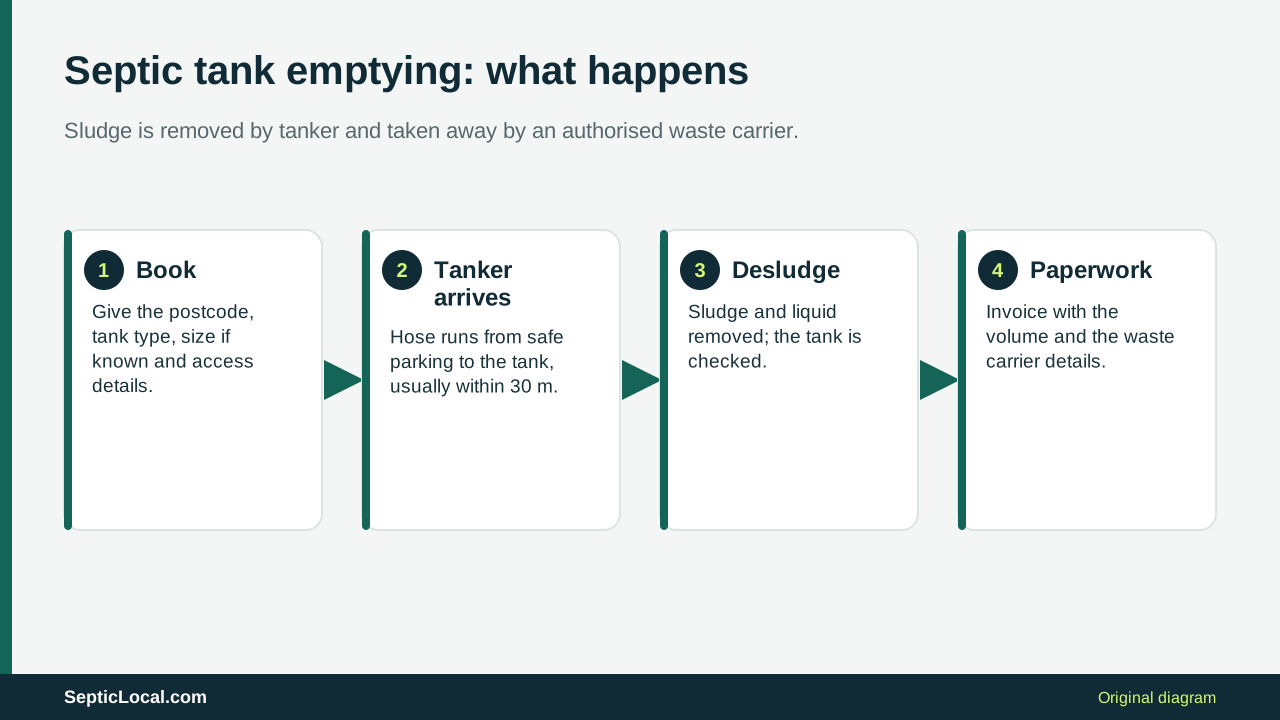
Explain where the contractor can park and how the hose would reach the tank. Mention narrow gates, turning restrictions, slopes, overhead obstacles and soft or recently disturbed ground. Ask the operator what dimensions or photographs it needs before confirming that its vehicle can attend.
Do not promise access across neighbouring land unless the arrangements have been agreed. If access is shared, identify who will open gates and keep the route clear on the day. Ask what happens to the charge if the vehicle cannot safely reach its agreed position. This is especially useful at properties where seasonal ground conditions change the available parking area.
Regular collections or one-off booking?
A recurring arrangement can make administration easier, but ask exactly what it commits you to. Check whether the provider automatically schedules visits, waits for you to request them or reviews the pattern after each collection. Those are different arrangements and can suit different properties.
Get the notice period, cancellation terms, price-review arrangements and emergency-contact process in writing. If visits are prepaid, ask what happens when the property is vacant or the business cannot attend. Compare the complete commitment with a one-off price instead of assuming that a recurring service always works out cheaper.
A cesspit-specific quote checklist
Use the same description when contacting more than one business. Ask each to identify any missing information before quoting. For a broader purchasing checklist, see comparing tank quotes.
- Confirm this is a cesspit or cesspool collection.
- State documented capacity and recent removed quantities, if known.
- Describe usual use, shared connections and busy periods.
- Confirm the quantity, disposal and transport included in the price.
- Ask for the complete payable total and any applicable VAT.
- Check vehicle access, hose reach and unsuccessful-visit terms.
- Agree repeat-booking arrangements and the process for urgent needs.
- Ask what records will be provided after each collection.
Records that make the next quotation easier
Keep the service date, recorded quantity, invoice total and provider details together. Add any explanation of extra charges or unusual access. Over several visits, the record helps you ask informed questions about the collection pattern and budget without trying to inspect the tank yourself.
If the property changes hands or a managing agent takes over, pass on the operating and service records. Agree who will monitor booking needs and receive the contractor’s messages. Shared systems work best administratively when the responsible contact and approval arrangements are clear before an urgent visit is needed.
Common questions about cesspit costs
Is the cheapest price per visit always the cheapest option?
No. Compare the included quantity, access assumptions, charges for additional work and likely number of visits. A smaller collection at a lower price may not provide the same service as another quotation.
Can I reduce costs by postponing a collection?
Arrange collections so the system does not overflow. Discuss the schedule with the provider rather than stretching an interval on price alone. Respond to alarms and emerging problems in line with professional advice.
Is this a quote from Septic Local?
No. Published examples are attributed to their providers. Septic Local is a directory: obtain your own quotation and confirm coverage, scope and availability directly.
Sources and review date
Reviewed 19 October 2026. Prices remain subject to the provider’s current quotation and conditions.
- West Wales Waste: published cesspit emptying price bands.
- GOV.UK: responsibilities for cesspools in England.
Ask a business about your collection needs
Find a listed contractor or browse locations, then confirm cesspit support directly. If you instead have a septic tank, use the separate septic tank emptying cost guide.
Get a written quote to compare
Tell us about the job and we will pass it to one listed contractor that covers your postcode and does this work. It is free, and you agree the price and visit directly with the business. Prefer to choose yourself? Call any business on this page.