

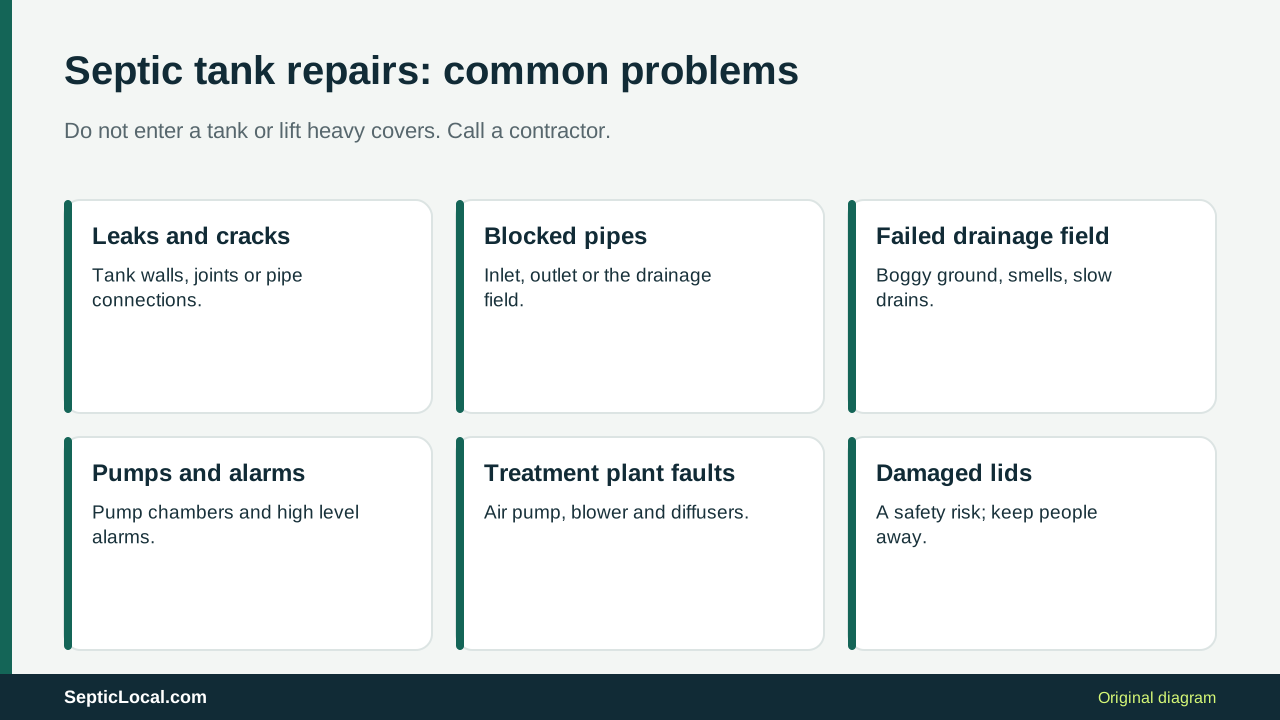
A fault does not automatically mean the whole septic tank must be replaced. Equally, a small repair is not always a lasting solution. The useful starting point is an assessment of what has failed, what the rest of the system is like and whether the proposed work will address the actual problem.
This guide helps you compare a repair with replacement before committing to major work. It covers the questions to ask, the evidence to request and the scope of the quotations. It does not diagnose a tank from a symptom or photograph. To find businesses advertising relevant work, use septic tank repairs and installation and replacement services.
Start by identifying the failed part
Ask the contractor to name the component or part of the installation it believes is responsible. The answer should distinguish the tank body, inlet or outlet connections, connected drains, pumps or controls, and the drainage field. A wet garden, smell or backing-up toilet does not identify one of those on its own.
Request an explanation of what has been checked and what remains uncertain. For example, a business might confirm a defective pump but need further assessment of the drainage arrangement. That is different from saying the complete system is beyond repair. Write down the diagnosis in ordinary language and ask what evidence supports it.
What a useful assessment should explain
Agree the assessment scope before booking. A camera survey of a pipe may answer a question about that pipe without establishing the condition of the tank or the suitability of the drainage field. A routine tanker visit may remove sludge without providing a structural report. Ask whether emptying, inspection, cameras and a written report are included or separately charged.
DASA’s published inspection information describes assessment of the tank, connected pipework and drainage field, with findings explained after inspection. Use that as an example of asking about the whole scope, not a promise that every provider supplies the same service. Our existing survey page can help you find a business to discuss an appropriate inspection.
- What problem is confirmed, rather than merely suspected?
- Which parts of the installation were inspected?
- What prevented a complete assessment, if anything?
- Are photographs, measurements or other observations available?
- Does the recommendation address the cause or only the immediate symptom?
- What follow-up checks would confirm that the work succeeded?
When a targeted repair may be worth considering
A contractor may offer a defined repair where it has identified a particular defective component and can explain how the proposed work deals with it. Ask about compatibility with the installed system, the condition of the surrounding material and whether anything else must be repaired for the solution to work.
Examples to discuss include a faulty pump, a damaged connection, a defective control component or an unsafe cover. These are questions for professional assessment, not a list of faults that can always be repaired. The suitability of any intervention depends on the actual equipment and findings.
For a repair proposal, ask for a written scope identifying the part, labour, access requirements, testing and any exclusions. If the work relies on the rest of the system being sound, ask how that assumption was checked. A price for replacing one component should not be mistaken for a guarantee covering an uninspected installation.
When replacement or wider work needs discussing
Replacement deserves consideration when the assessment identifies damage or limitations that a proposed repair will not resolve. Ask the contractor to explain the specific reason, rather than relying on a general statement that the tank is old. A sound answer should connect the findings to the proposed work and explain any alternatives that are technically appropriate.
Wider work might involve the drainage field or discharge arrangements rather than simply exchanging the tank. Ask whether a new tank alone would solve the reported problem. If an installer recommends a treatment plant, ask why that system is suitable for the site and what ongoing servicing it requires. Equipment selection should follow the assessment and relevant requirements.
In England, Environment Agency guidance requires systems that are not in good working order to be repaired or replaced. Its guidance also distinguishes the rules for different discharge circumstances and says changes to a treatment system may need reassessment. That does not establish which remedy your property needs: ask the installer to address the applicable requirements for the proposed work.
Compare complete scopes, not equipment prices
Ask each provider to price the same outcome. A supply-only tank figure is not comparable with a quotation covering design, excavation, installation, connections and reinstatement. A small repair may leave future maintenance costs or unresolved limitations that should be stated clearly. Replacement can also involve access and work outside the immediate tank area.
| Question | Repair quotation | Replacement quotation |
|---|---|---|
| What problem will this work solve? | Identify the defect and repaired component. | Identify why wider work is needed. |
| What assessment is included? | State what was inspected and tested. | State the design and site checks included. |
| What happens outside the tank? | Include relevant connected work or exclusions. | Include pipework, drainage and reinstatement scope. |
| How will the outcome be checked? | Explain tests and follow-up arrangements. | Explain commissioning and handover. |
| What remains your responsibility? | Explain ongoing maintenance and excluded faults. | Explain servicing, desludging and operating duties. |
For a fuller purchasing checklist, use comparing tank quotes. Keep copies of both the assessment and the proposed work, so any later discussion can refer back to the same findings.
If the drainage field is the concern
Ask the contractor to distinguish a tank problem from a problem with the area receiving its discharge. A recommendation to replace the tank should explain what happens to that downstream arrangement. If the drainage field requires work, request its own scope and the basis for the proposed solution.
Do not assume that a new tank makes existing ground conditions, pipework or discharge arrangements suitable. Ask what site assessment and design work are needed and who is responsible for providing them. The existing drainage field page gives you a starting point for finding relevant businesses.
How to think about the cost decision
List the quoted initial work, any confirmed follow-up work and the proposed routine maintenance. Ask what could increase the total, including access difficulties, excavation discoveries or additional waste removal. A clear quotation states its assumptions and the process for approving variations.
Do not use a generic online lifespan figure to calculate that a repair will definitely last a certain number of years. Ask what the provider is willing to say about this repair and this installation, including any warranty terms. A lower initial outlay may be sensible where it addresses a defined problem, but it is not good value if known necessary work has simply been left out.
When a second opinion is useful
Consider another suitably experienced provider where the proposed work is substantial, the diagnosis is unclear or the options differ significantly. Share the existing report and ask whether the second business agrees with the findings and scope. If it needs another visit, establish the charge and what additional information that visit will provide.
A second opinion should help explain disagreement, not just produce a lower equipment price. One contractor may be pricing an immediate component repair while another has included wider remedial work. Ask both to state what would remain unresolved after their proposal. Where an urgent safety issue exists, obtain prompt advice about making the area safe while the longer-term decision is considered.
Shared tanks and permissions
Where several homes use the same system, identify who can commission an assessment, approve work and arrange access before accepting a quotation. Check existing agreements and property documents, and obtain appropriate professional advice if responsibilities are disputed. This guide does not determine who must pay.
Ask the installer to identify any regulatory, building-control or planning checks that apply to the proposed replacement. The relevant arrangements differ between England, Wales, Scotland and Northern Ireland. Keep the advice and permissions with the final design and service documents rather than relying on a verbal assurance that everything is covered.
What to request at handover
Before the job starts, agree what records you will receive. Ask for an invoice identifying the work, relevant test or commissioning information, component or equipment details and any written warranty. Request operating instructions and the recommended maintenance contacts where new equipment is installed.
If the original symptom remains after the work, report it promptly with the invoice reference and a description of what is happening. Avoid commissioning additional work from someone else without understanding how it affects the first provider’s investigation or warranty arrangements. Keep the conversation factual and retain the records.
Common repair and replacement questions
Does an old septic tank have to be replaced?
Age alone does not explain the condition or the requirements for a particular installation. Ask for a site-specific assessment of the structure, operation and discharge arrangements.
Will emptying prove that the tank is sound?
No. Ask what inspection is included in the visit and whether a further assessment is recommended. Sludge removal and a condition survey have different purposes.
Can I repair a crack myself?
Do not enter or open a tank to investigate it. Ask a competent specialist to assess the damage and explain an appropriate remedy. A visible defect can be part of a wider problem.
Sources and further reading
Reviewed 19 October 2026. The legal references below describe England; use the appropriate nation’s requirements for a specific installation.
- Environment Agency: maintenance, repairs and changes to treatment systems in England.
- GOV.UK: discharge responsibilities and national guidance links.
- DASA: example of a published septic-system inspection scope.
- HSE: confined-space safety information.
Find the right business for an assessment
Browse listed contractors and ask about experience with your system, the inspection scope and the report provided. Confirm coverage and availability directly. Septic Local is a directory and does not diagnose faults, approve installations or guarantee a provider’s recommendation.
Ready to book? Get a quote
Tell us about the job and we will pass it to one listed contractor that covers your postcode and does this work. It is free, and you agree the price and visit directly with the business. Prefer to choose yourself? Call any business on this page.