

What a drainage field does
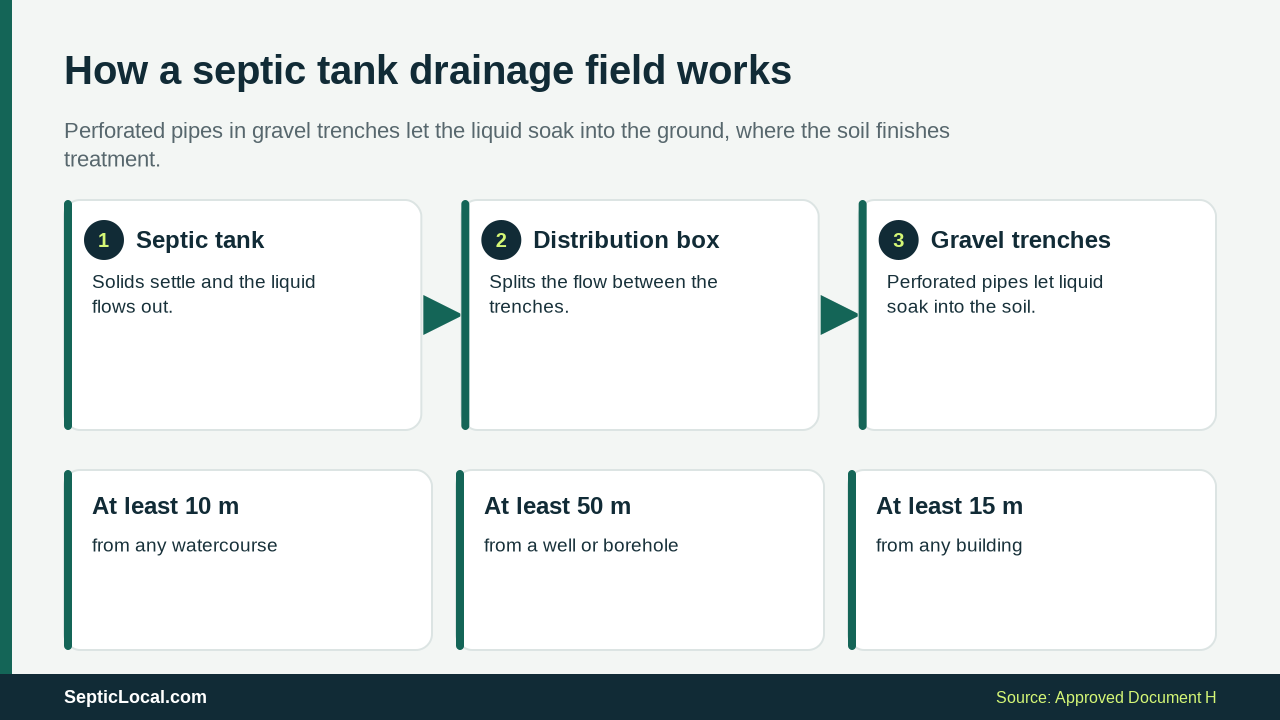
A drainage field (also called an infiltration system or, often, a soakaway) is a network of perforated pipes laid in gravel trenches. It lets the liquid from a septic tank soak slowly into the ground, where the soil finishes the treatment. In England, a septic tank that discharges to the ground must do so through a drainage field under the general binding rules.
Signs a drainage field is failing
- Wet, boggy or unusually green ground over the field.
- A sewage smell in the garden.
- Slow drains or gurgling in the house, even soon after the tank was emptied.
- Sewage surfacing or running off the land.
If the tank was emptied recently and the signs remain, the field may be blocked or the ground saturated. See signs your septic tank is full. If sewage is reaching a stream or a neighbour's land, report it using the GOV.UK environmental incident service.
Rules for a new or replacement field
Approved Document H gives the usual siting distances: at least 10 m from any watercourse or permeable drain, at least 50 m from a groundwater supply such as a well or borehole, and at least 15 m from any building. A percolation test checks the ground can take the water. Approved Document H says a drainage field should only be used where the average result (Vp) is between 12 and 100. The general binding rules cap discharges to the ground at 2 cubic metres a day.
Repair or replace?
Sometimes a blocked distribution box or a crushed pipe can be repaired. If the ground around the pipes has become clogged, a new field in fresh ground is often needed. Ask the contractor to explain the evidence, such as a CCTV inspection or a test pit, before you agree to a replacement.
Before you book
- Where the existing system discharges, if known.
- Previous surveys or ground assessments.
- Scope of excavation, testing and garden reinstatement.
Agree the scope of work
Explain your system type, the property location and what you want the visit to achieve. Ask whether the first appointment is an assessment, an emptying visit or the work itself. Get a written description so you can compare like-for-like quotes.
What affects the price?
Travel, access, waste volume, specialist equipment and the time needed can change the quote. Confirm VAT, disposal, additional visits and any charge if the tanker or engineer cannot gain access. For repair or installation work, agree who authorises extra parts or excavation.
Use the quote comparison checklist.
Soakaway and percolation tests
Before a new drainage field or soakaway is dug, the ground needs a percolation test, sometimes called a soakage or soakaway test. Holes are dug to the depth of the field, filled with water and timed as they drain. The result shows whether the soil can take the water and how long the field needs to be. Building control will ask for it. A failed test does not always rule out off mains drainage, but it may point to a treatment plant or a different outfall.
What is a soakaway drain?
A soakaway is a pit or crate system that lets water soak into the ground. For septic tanks, a drainage field of perforated pipes in gravel trenches spreads the water more widely and is the usual modern choice. Old single pit soakaways often clog and are a common reason for tanks backing up.
Businesses advertising this service
Reviewed 8 October 2026. Confirm postcode and system support directly.
Clearmasters
Smallfield, Surrey
Advertises septic and cesspit emptying, treatment-plant maintenance and drainage services across the South East.
View business detailsCall this business03333 233566
CH Services
Alfold, Cranleigh, Surrey
Offers tank conversions, treatment-plant installation, drainage fields and inspections in Surrey, West Sussex and Hampshire.
View business detailsCall this business01483 277777
Drain Detectives
South East service area
Advertises septic tank and cesspit emptying, treatment-plant work and installations across named South East counties.
View business detailsCall this business0800 357 9371
If you are buying a property, ask the seller where the drainage field is and when it was last looked at. A field under a new patio or driveway is a common and expensive surprise.
Get a quote from a local contractor
Tell us about the job and we will pass it to one listed contractor that covers your postcode and does this work. It is free, and you agree the price and visit directly with the business. Prefer to choose yourself? Call any business on this page.
Common questions
What is the difference between a soakaway and a drainage field?
The terms are often used loosely. A drainage field spreads septic tank effluent through perforated pipes in trenches. A rainwater soakaway takes surface water only and should not take sewage.
How long does a drainage field last?
It depends on the ground, the size of the field and how well the tank is maintained. Regular emptying helps by stopping solids reaching the field.
Do I need approval for a new drainage field?
In England, check with building control. New discharges need the necessary planning and building control approvals under the general binding rules.
Can a septic tank discharge to a ditch instead?
Not in England. A septic tank must discharge to the ground through a drainage field. Discharges to water must come from a treatment plant.
Who carries out a percolation test?
Many installers and drainage contractors do. Ask whether the test is included in an installation quote and whether you get a written result for building control.
Sources
- GOV.UK: general binding rules for small sewage discharges
- Approved Document H: drainage and waste disposal (PDF)
- GOV.UK: report an environmental incident
Sources checked 13 October 2026. Rules can change, so check the source before acting.