

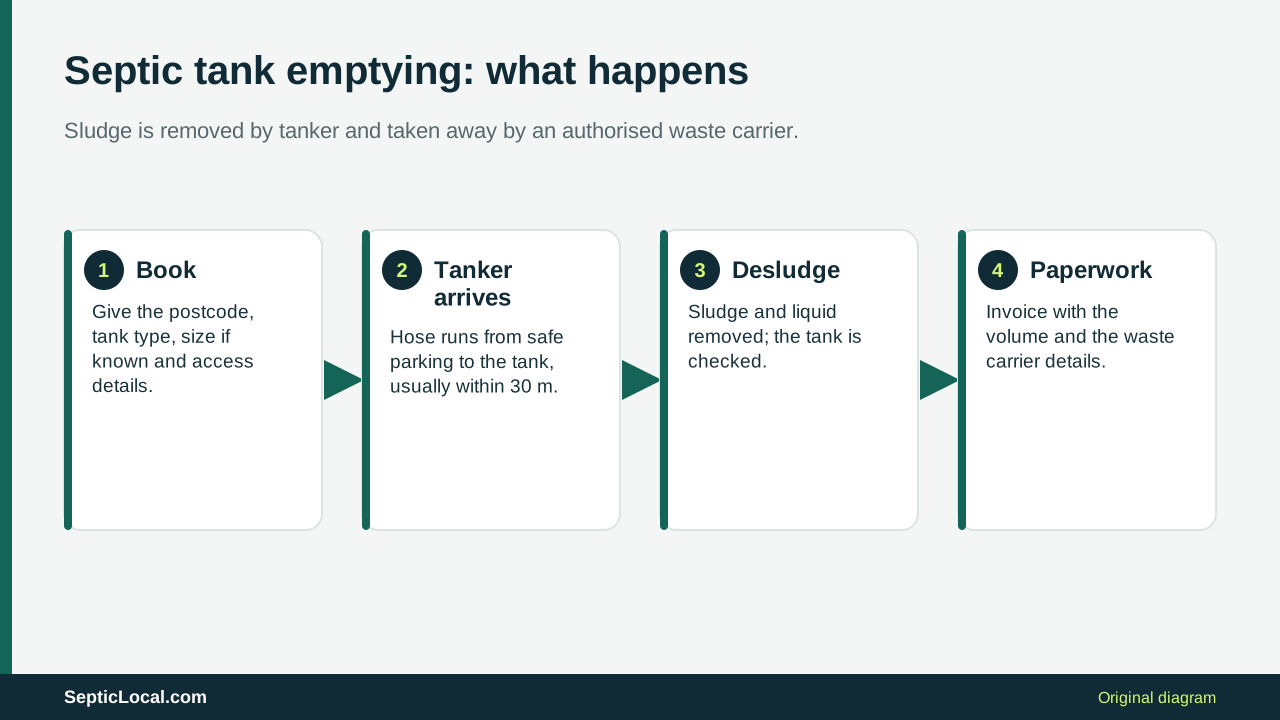
Plan septic tank emptying around the system’s instructions and maintenance advice, rather than waiting for an overflow. In England, the Environment Agency says sludge must be removed before it exceeds the system’s maximum capacity; its guidance recommends at least annual removal or following the manufacturer’s instructions. That is an England-specific reference, not a universal rule for every UK installation.
The practical question is how to turn that guidance into a schedule for your home. This guide covers existing records, changes in household use, treatment-plant servicing and what to ask after an emptying visit. If you need to contact a provider, use our emptying and pumping service page.
First, make sure you are scheduling the right service
Identify whether you have a septic tank, a sealed cesspit or a sewage treatment plant. These are not interchangeable descriptions. A septic tank needs sludge removed as part of maintenance. A cesspit stores sewage for collection. A treatment plant needs its manufacturer’s maintenance and desludging arrangements followed, including any separate work on its equipment.
Use the operating manual, installation record, previous invoices or a survey report. Do not try to identify a tank by opening it. If the documents are missing, explain that to a contractor and ask what assessment is appropriate. Our guide to tank types and UK guidance explains the starting distinctions.
| System | What to ask the provider | What not to assume |
|---|---|---|
| Septic tank | What sludge-removal interval fits this system and its use? | That visible liquid means the tank needs pumping today. |
| Cesspit or cesspool | How will collection be arranged before the usable storage is exhausted? | That an annual septic-tank schedule applies. |
| Small treatment plant | Which servicing tasks and desludging visits does the model require? | That pumping alone is a complete mechanical service. |
What to do with the manufacturer’s instructions
Find the section covering routine maintenance and sludge removal. Note any stated intervals, inspection requirements and restrictions on when work should take place. Keep the model name with the document so an engineer can check that the instructions actually match your equipment. An old leaflet left at a property may relate to a previous installation.
If the instructions and your past booking pattern seem inconsistent, ask the maintenance business to explain the difference. A recommendation may account for the way the system is used, but you should understand the reason. Request it in writing, with the next review or appointment date. Where the instructions are unavailable, obtain advice about that particular system instead of adopting a timetable from a different household.
Household information worth giving the contractor
Describe the number of usual residents and whether use has changed since the previous visit. Mention long stays by visitors, a property becoming a holiday let, a home becoming permanently occupied or an additional connected building. These are useful questions for an assessment; they do not let a website calculate a safe interval for you.
Tell the contractor about repeated drainage problems and recent work as well. A blocked pipe, an unfamiliar alarm or a persistent wet patch may need investigation independently of a scheduled empty. Ask which visit you should book before assuming that every symptom will be fixed by a tanker.
Use a short record for the conversation:
- System type, model and approximate age, if documented.
- Date and scope of the previous emptying and service appointments.
- Usual occupancy and any recent change in use.
- Known alterations, building work or connected properties.
- Symptoms, when they started and any previous findings.
- Access restrictions that affect future bookings.
Does a tank full of liquid need emptying?
The presence of liquid alone does not establish how much sludge has accumulated or whether a septic system is working correctly. Do not lift a cover to judge the level yourself. Describe any symptoms and ask a competent contractor how the system should be assessed. The meaning of “full” is different for a holding tank and a septic tank with an outlet.
A calendar reminder and a high-level alarm also answer different questions. A reminder helps you arrange routine maintenance. An alarm needs a response based on the equipment instructions and professional advice. Neither should be ignored because the other has not appeared. For symptoms rather than scheduling, read the existing guide to full-tank warning signs.
Check the guidance for your UK nation
England’s general binding rules should not be presented as a UK-wide registration or approval. The government’s overview links to separate arrangements for Wales, Scotland and Northern Ireland. Use the relevant regulator and your system documents when arranging maintenance.
Natural Resources Wales publishes a household sewage-system care guide with practical advice on desludging and records. In Scotland, use SEPA for regulatory questions and your service provider for the maintenance arrangements. In Northern Ireland, NI Water offers a discretionary domestic desludging service subject to conditions; access to that service is not confirmation that a system never needs another maintenance visit.
If you have a permit, registration, consent or written maintenance condition, have it available when you speak to the contractor. A service provider needs to know about it. Keep the distinction clear between the recommended visit pattern, the services a water company offers and the regulatory requirements for the installation.
What if you do not know when the tank was last emptied?
Look for invoices, a property information pack, the service company’s contact details or notes from a previous owner. If the system is shared, another household or managing agent may hold the records. Do not invent a recent date just to obtain an online quotation. Tell the provider that the history is uncertain.
Ask whether the next step should be a planned desludge, an inspection or a combined visit. Those services have different scopes. If the system has current symptoms, explain them before accepting a routine booking. After the assessment, start a new record with the provider’s findings and recommendation so the same uncertainty does not continue into the following year.
Questions to ask after the emptying visit
The end of the visit is a useful point to agree the next step. Ask the business to explain anything it observed and distinguish a confirmed finding from a possible concern. A tanker visit may not include a full condition survey, so do not treat the absence of a report as proof that every part of the installation has been inspected.
- What work was carried out, and what quantity was recorded?
- Did anything make the job different from the booking assumptions?
- Is another service or investigation recommended?
- What is the proposed next emptying or review date?
- What observation or change in use should make me contact you earlier?
- Which paperwork should I retain with the system manual?
Ask for an invoice or service record and keep it somewhere another responsible household member can find. Where a contractor proposes a different interval from previous advice, request the explanation rather than choosing whichever date is furthest away.
What if the problem returns soon after pumping?
Contact the provider with the date of the visit and the symptoms that have returned. Repeated pumping should not be treated as a diagnosis. Ask what assessment is needed to distinguish the tank from connected pipework, equipment or the drainage field. Note whether the issue appears during heavy rain, after a change in use or continuously, without attempting to inspect an opening yourself.
The next appointment may need a different specialist or a defined survey scope. Read what tank surveys can cover and drainage field services before discussing the options. For decisions about a confirmed fault, our repair or replacement guide sets out questions to ask.
A simple maintenance reminder you can keep
Record three dates separately: the last sludge-removal visit, the last equipment service and the next recommended appointment. Add the contractor’s name, invoice reference and any follow-up work. A single note saying “tank done” is not enough if one business emptied it and another services the treatment equipment.
Put a booking reminder ahead of the due date so you have time to discuss access and availability. Keep the recommended interval attached to the note, especially if the property is sold, let or managed by someone new. If household use changes, ask whether the schedule needs reviewing instead of automatically carrying the old reminder forward.
Common scheduling questions
Can I follow my neighbour’s emptying timetable?
Use it only as a prompt to ask questions. Their equipment, loading, discharge arrangement and service conditions may differ from yours. Obtain advice for your own installation.
Does a treatment-plant service include pumping?
Check the booking scope. A service visit and a desludge can be supplied separately. Ask who arranges each appointment and which records you will receive.
Can additives replace scheduled sludge removal?
Do not change a recommended maintenance plan because a product claims to reduce emptying. Discuss the product with the equipment manufacturer or maintenance engineer. Our existing guide to septic tank treatments examines this question separately.
Sources and further reading
Reviewed 19 October 2026. Check the current instructions for your installation and nation.
- Environment Agency: maintenance and desludging guidance for England.
- GOV.UK: operator responsibilities and links to the other UK nations.
- Natural Resources Wales: household sewage-system care guide.
- NI Water: domestic desludging service and conditions.
Find someone to discuss the next visit
Find a listed contractor and confirm that it supports your system and postcode. For a realistic budget, read the new emptying cost guide. Septic Local helps you find contacts; bookings and maintenance recommendations are agreed directly with the provider.
Ready to book? Get a quote
Tell us about the job and we will pass it to one listed contractor that covers your postcode and does this work. It is free, and you agree the price and visit directly with the business. Prefer to choose yourself? Call any business on this page.