

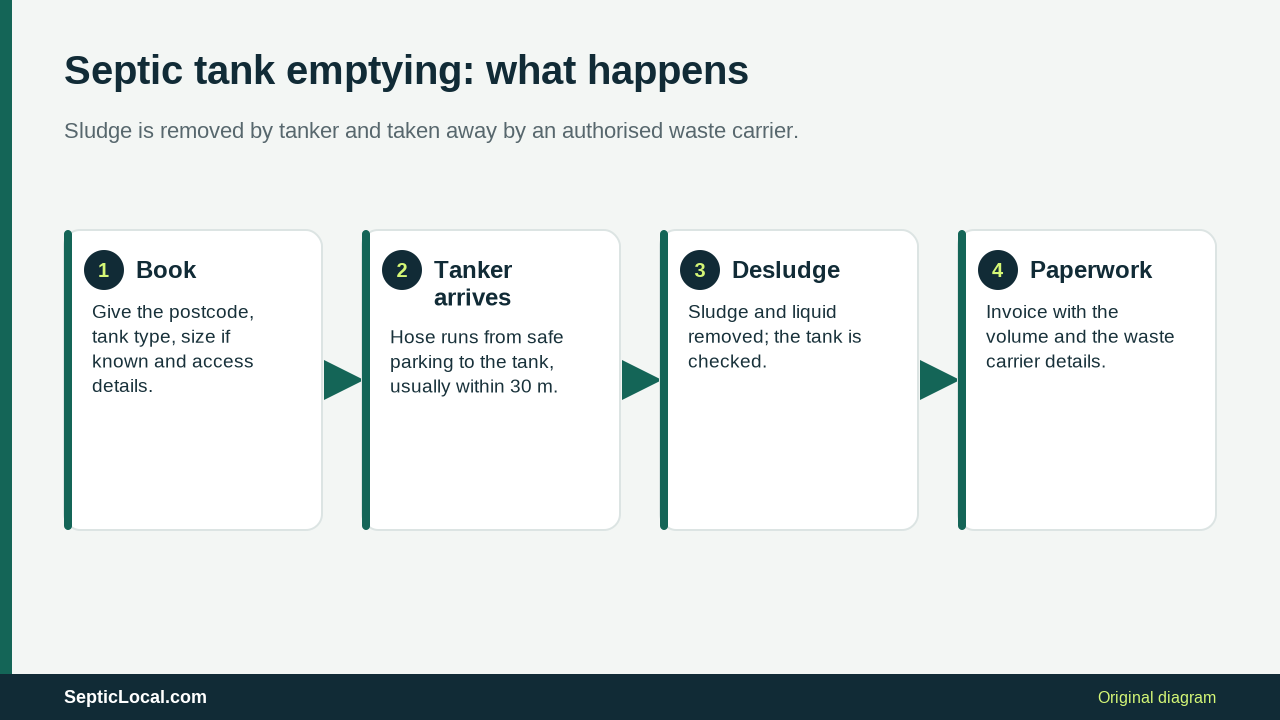
How often should a septic tank be emptied?
In England, GOV.UK guidance says you must have the sludge removed from a septic tank or small sewage treatment plant, and you should do this at least once a year or in line with the manufacturer's instructions. In Wales, Natural Resources Wales says desludging must only be carried out by an authorised person. Scotland (SEPA) and Northern Ireland (NIEA) have their own rules.
The number of people in the house, how much water you use and the size of the tank all affect how quickly sludge builds up. Your contractor can suggest a schedule after the first empty.
Emptying, pumping and desludging
These words describe the same job: a tanker pumps out the tank so solids do not build up and block the outlet or drainage field. What changes is the system:
- Septic tank. Solids settle and liquid flows out to a drainage field or soakaway. The tank is emptied to remove the sludge.
- Cesspit or cesspool. A sealed holding tank with no outlet. Everything stays in the tank, so it needs emptying whenever it fills, far more often than a septic tank.
- Sewage treatment plant. Desludging is usually part of regular servicing. See treatment plant servicing.
Not sure which you have? Read septic tank, cesspit or treatment plant: where to start.
Signs your tank is due
- Slow drains around the whole house
- Gurgling from drains or toilets
- Sewage smells near the tank or drainage area
- Wet or boggy ground over the drainage field
- You cannot remember the last empty
More detail in our guide to the signs your septic tank is full. To make the tank last longer between empties, see what is safe to put in a septic tank and whether septic tank treatments work.
Before you book
- Tank type and approximate capacity, if known.
- Date of the last empty and any recent changes.
- Parking, hose distance, narrow lanes and restricted access.
Agree the scope of work
Explain your system type, the property location and what you want the visit to achieve. Ask whether the first appointment is an assessment, an emptying visit or the work itself. Get a written description so you can compare like-for-like quotes.
What affects the price?
Travel, access, waste volume, specialist equipment and the time needed can change the quote. Confirm VAT, disposal, additional visits and any charge if the tanker or engineer cannot gain access. For repair or installation work, agree who authorises extra parts or excavation.
Use the quote comparison checklist.
Where the waste goes
Sludge from your tank is waste, and you have a duty of care for it. In England, GOV.UK says the company that takes it away must be a registered waste carrier. Ask for the contractor's registration details and check them on the Environment Agency public register. Carriers registered in Scotland or Wales are also authorised to operate in England.
Ask for a waste transfer note or receipt and keep it with your records. East Suffolk Council warns that if waste from your property is fly-tipped and you cannot show who you gave it to, you can be fined. Records also help when you sell: see buying a house with a septic tank.
Septic tank cleaning and emptying: the same job?
Yes, in practice. When people search for septic tank cleaning they usually mean a tanker visit to remove the sludge and scum, which is what contractors call emptying or desludging. A few firms also jet the inlet and outlet pipes or wash down the tank walls while they are there. If you want that, ask for it by name, because it is not always included.
Emergency septic tank emptying
If sewage is backing up into the house, overflowing from the lid or flooding the garden, stop using water and call a contractor that advertises a 24 hour line. Keep children and pets away. An overflowing tank is often a sign of a blocked outlet or a failed drainage field as well as a full tank, so ask the firm to check the cause, not just empty it.
Cesspits need a different plan
A cesspit has no outlet, so it fills completely and needs emptying far more often than a septic tank. If you are not sure which you have, ask the contractor before you book. See our cesspit emptying page for collection schedules, and our septic tank emptying cost guide for published prices.
Businesses advertising this service
Reviewed 8 October 2026. Confirm postcode and system support directly.
Clearmasters
Smallfield, Surrey
Advertises septic and cesspit emptying, treatment-plant maintenance and drainage services across the South East.
View business detailsCall this business03333 233566
Drain Detectives
South East service area
Advertises septic tank and cesspit emptying, treatment-plant work and installations across named South East counties.
View business detailsCall this business0800 357 9371
Greenwoods Waste Disposal
Hitcham, Suffolk
Domestic septic tank emptying, installations and site surveys, with published coverage in Suffolk and neighbouring areas.
View business detailsCall this business01449 740286
Drainforce
Bridgend and Tenby, Wales
Advertises septic tank and cesspit emptying across South and West Wales, with inspection and repair options.
View business detailsCall this business0800 6546399
Walsh Brothers
Alloa, Scotland
Offers septic tank and cesspit emptying for households in named areas of Scotland’s Central Belt.
View business detailsCall this business01259 214507
Universal Tankers
England and Scotland service network
Advertises domestic and commercial septic tank emptying through its England and Scotland operations.
View business detailsCall this business0800 180 4474
Get a quote from a local contractor
Tell us about the job and we will pass it to one listed contractor that covers your postcode and does this work. It is free, and you agree the price and visit directly with the business. Prefer to choose yourself? Call any business on this page.
Common questions
Is septic tank pumping the same as emptying?
Yes. Pumping, emptying and desludging all describe a tanker removing the sludge and liquid from the tank. Cesspit emptying works the same way, but a cesspit holds all the waste, so it fills up much faster.
How often should a septic tank be emptied?
In England, GOV.UK guidance says you should have the sludge removed at least once a year or in line with the manufacturer's instructions. A cesspit needs emptying whenever it fills. Wales, Scotland and Northern Ireland have their own regulators, so check the guidance for your nation.
How much does septic tank emptying cost?
There is no fixed price. Tank size, the volume removed, access for the tanker, hose distance, travel and disposal charges all change the quote. Ask each contractor what is included and compare like for like using our quote comparison checklist.
Who is allowed to empty a septic tank?
In England the company that takes the sludge away must be a registered waste carrier. You can check a carrier on the Environment Agency public register. In Wales, Natural Resources Wales says desludging must only be done by an authorised person.
Do I need to be home when the tank is emptied?
Ask the contractor. They usually need a clear route for the hose, access to the tank lid and somewhere safe to park the tanker. Tell them about locked gates, pets and soft ground before the visit.
Does this book an appointment?
No. Contact your chosen contractor to agree a visit. The optional help-request form saves an enquiry for owner review, not a confirmed appointment.
Can I assume the same rules apply across the UK?
No. Regulatory requirements differ between England, Wales, Scotland and Northern Ireland. Use the relevant regulator's guidance and ask the contractor to explain the requirements for your property.
Do you need to clean a septic tank as well as empty it?
Usually not. Emptying removes the sludge and scum, which is the cleaning the tank needs. Leave a little liquid in the bottom so the bacteria recover quickly.
Is there an emergency septic tank emptying service near me?
Several listed contractors advertise 24 hour lines. Use the directory filter for your postcode, then check each firm's emergency hours on its profile.
Septic tank emptying by area
Location pages show which listed contractors say they cover each area. In Guildford there is also a dedicated septic tank emptying in Guildford page.
Sources
- GOV.UK: general binding rules, discharge to the ground (England)
- Natural Resources Wales: small sewage discharge guidance (PDF)
- SEPA: septic tanks and private sewage (Scotland)
- DAERA: septic tank consents (Northern Ireland)
- Environment Agency: public register of waste carriers
- East Suffolk Council: householders' duty of care
Sources checked 9 October 2026. Rules can change, so check the source before acting.