

Septic tank or treatment plant?
In England the general binding rules decide which system can be used where the treated water goes:
- To the ground: a septic tank must discharge through a drainage field (infiltration system). A treatment plant can also discharge to the ground.
- To a stream, river or ditch: the sewage must be treated by a sewage treatment plant. A septic tank cannot discharge straight to water.
The rules also cap the volume: 2 cubic metres a day or less to the ground, and 5 cubic metres a day or less to surface water. Larger discharges need a permit from the Environment Agency.
Where a new system can go
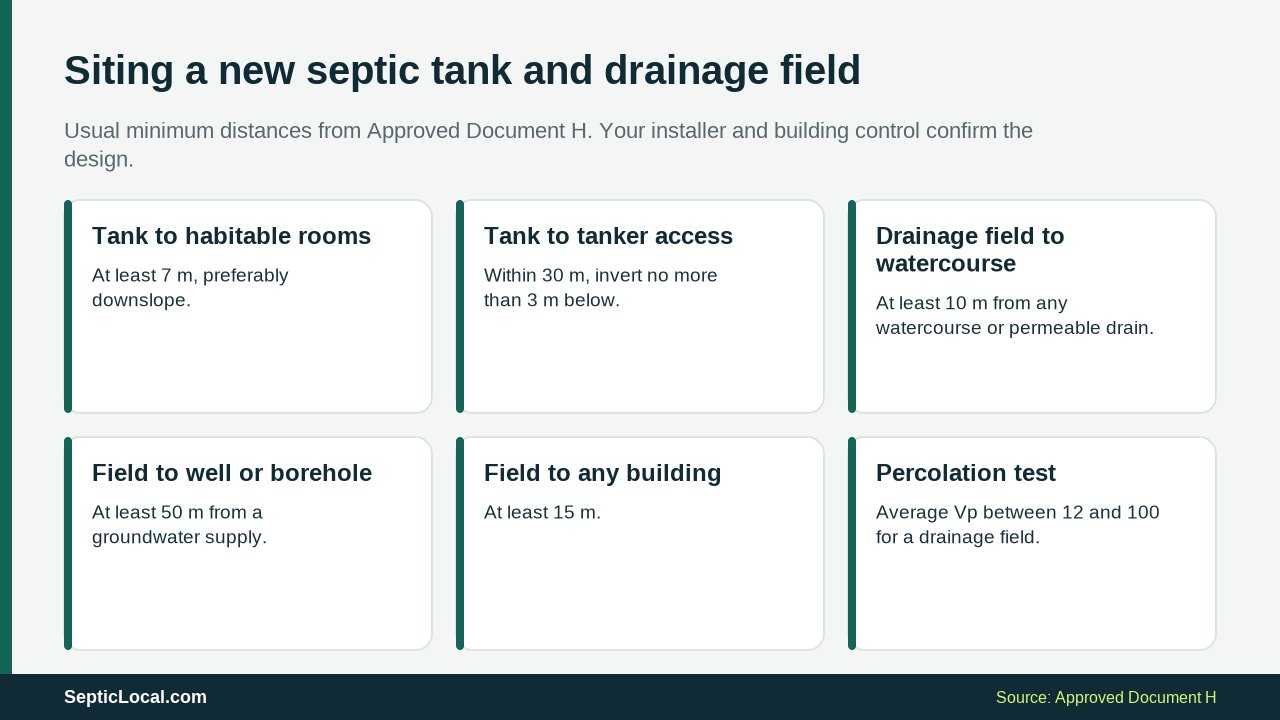
Approved Document H of the Building Regulations gives the usual siting distances:
| What | Distance |
|---|---|
| Septic tank or plant from habitable parts of buildings | At least 7 m |
| Tank from vehicle access for emptying | Within 30 m (invert no more than 3 m below access) |
| Drainage field from any watercourse or permeable drain | At least 10 m |
| Drainage field from a groundwater supply (well, borehole) | At least 50 m |
| Drainage field from any building | At least 15 m |
A percolation test shows whether the ground can take a drainage field. Approved Document H says a drainage field should only be used where the average test result (Vp) is between 12 and 100.
Approvals and standards
- England: new discharges must have planning and building control approvals in place (general binding rule 16), and the system must meet the British Standard in force when it is installed. The current standard for small sewage treatment plants is BS EN 12566.
- Wales: Natural Resources Wales requires small sewage discharges to be registered.
- Scotland: SEPA regulates septic tanks and treatment plants, including registration.
- Northern Ireland: a discharge consent is needed from the Northern Ireland Environment Agency (DAERA).
Ask the installer who will handle the building control application, any registration, and commissioning.
What a good installation quote includes
- A site survey and percolation test, or the results of one.
- The system type, size and the standard it meets, sized for the number of people in the property.
- Excavation, the drainage field or outfall, connection to the house drains and reinstatement of the ground.
- Building control and any registration or permit work.
- Commissioning, the first service and the manufacturer's warranty.
- Removal or decommissioning of the old tank.
Use our quote comparison checklist and the guide to tank types and UK rules.
Before you book
- Property use and expected number of users.
- Existing system and any available plans.
- Who handles design, permissions, commissioning and reinstatement.
Agree the scope of work
Explain your system type, the property location and what you want the visit to achieve. Ask whether the first appointment is an assessment, an emptying visit or the work itself. Get a written description so you can compare like-for-like quotes.
What affects the price?
Travel, access, waste volume, specialist equipment and the time needed can change the quote. Confirm VAT, disposal, additional visits and any charge if the tanker or engineer cannot gain access. For repair or installation work, agree who authorises extra parts or excavation.
Use the quote comparison checklist.
Choosing septic tank installers
Ask every installer the same questions so the quotes compare. Which tank will you fit and why? Will you carry out a percolation test? Who applies for building control approval? Does the price include the drainage field, removing the old tank and reinstating the garden? What warranty covers the tank and the work? Firms that install and empty often offer the first empty or service as part of the job.
If your site discharges to a stream or ditch, or the ground drains poorly, you may need a treatment plant rather than a septic tank. See our sewage treatment plant installers page.
Businesses advertising this service
Reviewed 8 October 2026. Confirm postcode and system support directly.
CH Services
Alfold, Cranleigh, Surrey
Offers tank conversions, treatment-plant installation, drainage fields and inspections in Surrey, West Sussex and Hampshire.
View business detailsCall this business01483 277777
Drain Detectives
South East service area
Advertises septic tank and cesspit emptying, treatment-plant work and installations across named South East counties.
View business detailsCall this business0800 357 9371
Greenwoods Waste Disposal
Hitcham, Suffolk
Domestic septic tank emptying, installations and site surveys, with published coverage in Suffolk and neighbouring areas.
View business detailsCall this business01449 740286
Get a quote from a local contractor
Tell us about the job and we will pass it to one listed contractor that covers your postcode and does this work. It is free, and you agree the price and visit directly with the business. Prefer to choose yourself? Call any business on this page.
Common questions
Do I need planning permission for a new septic tank?
In England, the general binding rules say new discharges must have the necessary planning and building control approvals in place. Check with your local authority, and ask the installer to confirm what applies.
Can I replace a septic tank with a treatment plant?
Yes, and in England it is required if your septic tank discharges straight to a watercourse. GOV.UK says you must connect to a sewer, fit a treatment plant or install a drainage field, usually within 12 months.
How close to the house can a septic tank be?
Approved Document H says at least 7 m from habitable parts of buildings, and within 30 m of vehicle access for emptying.
What is a percolation test?
A test of how quickly water soaks into the ground where a drainage field would go. Approved Document H gives the method and says the average result (Vp) should be between 12 and 100.
Who is responsible for the system?
The operator, usually the property owner. Responsibility can be shared where several properties use one system.
How do I find septic tank installers near me?
Use the directory filter for installations and your postcode, or browse by area. Ask at least two firms for written quotes that include the drainage field and approvals.
Sources
- GOV.UK: general binding rules for small sewage discharges
- GOV.UK: small sewage discharge to surface water
- Approved Document H: drainage and waste disposal (PDF)
- Natural Resources Wales: registering small sewage discharges (PDF)
- SEPA: septic tanks and private sewage treatment systems
- DAERA: septic tank consents
Sources checked 13 October 2026. Rules can change, so check the source before acting.