

Common problems contractors repair
Listed contractors advertise work on problems such as:
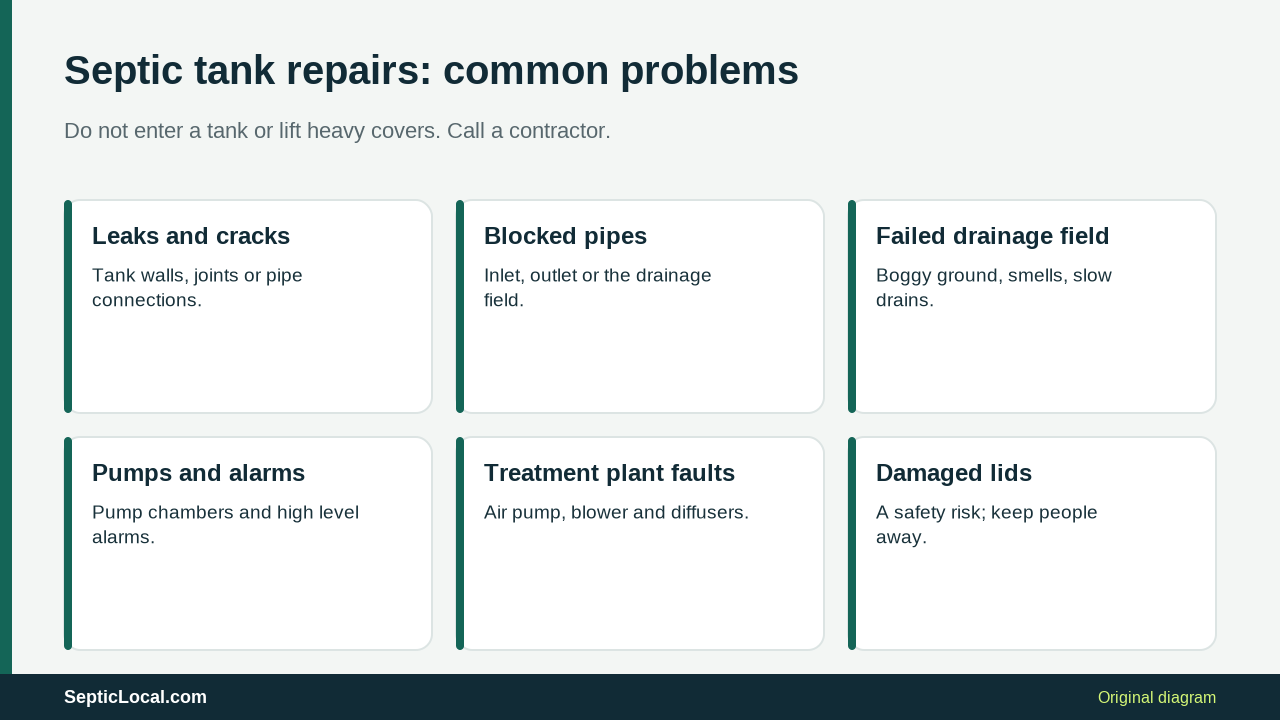
- Leaking or cracked tanks, including leaks at the inlet or outlet pipe
- Blocked, broken or collapsed pipes between the house, the tank and the drainage area
- Failing drainage fields or soakaways, often shown by wet ground or pooling water. See drainage fields.
- Treatment plant faults, such as an air pump (blower), control panel or alarm problem. See treatment plant servicing.
- Pump failures where waste is pumped uphill or to a distant drainage point
- Damaged lids and covers, which are a safety risk and should be made safe quickly
Guides to common faults: leaking septic tanks, treatment plant air pump problems and sewage smells in the house or garden.
Your responsibility
In England, GOV.UK guidance says you must have your treatment system repaired or replaced if it is not in good working order. It gives pools of water around the drainage point as an example of a problem. If the system cannot meet the rules, you must connect to a public sewer, change the system or apply for a permit. Wales, Scotland and Northern Ireland have their own regulators: NRW, SEPA and NIEA.
Before you book
- What you noticed and when it started.
- Any alarm message visible without opening equipment.
- Assessment fees and approval for additional work.
Agree the scope of work
Repairs often start with a diagnosis. Ask whether the first visit includes emptying the tank, a camera survey of the pipes or a test of the drainage area, and what each costs. Agree in writing what the contractor can do without asking you first, especially if digging is needed.
What affects the price?
The cause of the fault, whether the tank must be emptied first, digging and access for machinery, replacement parts such as pumps or blowers, and putting the ground back afterwards all change the cost. Confirm VAT, disposal, return visits and any charge if the engineer cannot gain access. Agree who authorises extra parts or excavation before work starts.
Use the quote comparison checklist.
If sewage is leaking onto land or into water
Keep people and pets away and contact a contractor. If sewage is reaching a stream, ditch or someone else's land, report it. In England use the GOV.UK report an environmental problem service: the Environment Agency's 24-hour incident hotline is 0800 80 70 60 for pollution to land, and water pollution has its own online form. The same page links to the reporting services for Wales, Scotland and Northern Ireland.
If a neighbour's tank is the problem, speak to them first. Councils must investigate complaints about possible statutory nuisances, so your local council's environmental health team is the next step if it is not resolved.
Septic tank repair or replacement?
Many faults can be repaired: a broken T-piece, a cracked lid, a blocked baffle or a root in the outlet pipe. Replacement makes more sense when the tank itself is cracked or collapsing, when it is too small for the household, or when it discharges to a watercourse and the rules mean it must be upgraded anyway. Our repair or replacement guide walks through the decision.
Finding septic tank repairs near you
Not every tanker firm repairs tanks. Use the businesses below, or browse by area on our locations page, and check each profile for the work it lists. If you are in Shropshire, Aberdeenshire or Devon, see the Shropshire, Aberdeenshire and Exeter pages for local firms that repair as well as empty.
Businesses advertising this service
Reviewed 8 October 2026. Confirm postcode and system support directly.
Clearmasters
Smallfield, Surrey
Advertises septic and cesspit emptying, treatment-plant maintenance and drainage services across the South East.
View business detailsCall this business03333 233566
Drain Detectives
South East service area
Advertises septic tank and cesspit emptying, treatment-plant work and installations across named South East counties.
View business detailsCall this business0800 357 9371
Drainforce
Bridgend and Tenby, Wales
Advertises septic tank and cesspit emptying across South and West Wales, with inspection and repair options.
View business detailsCall this business0800 6546399
Get a quote from a local contractor
Tell us about the job and we will pass it to one listed contractor that covers your postcode and does this work. It is free, and you agree the price and visit directly with the business. Prefer to choose yourself? Call any business on this page.
Common questions
Can a leaking septic tank be repaired?
Sometimes. It depends on where the leak is, the tank material and its condition. A contractor will usually need the tank emptied to inspect it, then explain whether a repair or a replacement makes sense. Ask for the options and costs in writing.
My treatment plant alarm is sounding. What should I do?
Follow the manufacturer's instructions for your model, cut down water use and call a service engineer. Do not open electrical panels or lift heavy covers yourself.
Is it a repair, or does the tank just need emptying?
If the tank has not been emptied in the last year, start there. If problems come back soon after an empty, the fault is more likely to be in the pipes, drainage field or equipment. See our guide to the signs your septic tank is full.
Who pays to repair a shared septic tank?
It depends on the property deeds and any agreement between the households. Check the paperwork, and ask a solicitor or conveyancer if it is unclear.
Does this book an appointment?
No. Contact your chosen contractor to agree a visit. The optional help-request form saves an enquiry for owner review, not a confirmed appointment.
Can I assume the same rules apply across the UK?
No. Regulatory requirements differ between England, Wales, Scotland and Northern Ireland. Use the relevant regulator's guidance and ask the contractor to explain the requirements for your property.
How do I know if my septic tank needs repairing or just emptying?
If problems come back soon after an empty, such as slow drains, smells or a wet patch over the drainage field, something is likely damaged or blocked. Ask the contractor to inspect the tank and outlet while it is empty.
Find contractors by area
Sources
- GOV.UK: general binding rules, discharge to the ground (England)
- GOV.UK: report an environmental problem
- GOV.UK: statutory nuisances, how councils deal with complaints
- Natural Resources Wales: small sewage discharge guidance (PDF)
- SEPA: septic tanks and private sewage (Scotland)
- DAERA: septic tank consents (Northern Ireland)
Sources checked 9 October 2026. Rules can change, so check the source before acting.