

In short, septic tank regulations are set separately in each UK nation. England uses the general binding rules, Wales asks for registration with Natural Resources Wales, Scotland asks for registration with SEPA, and Northern Ireland asks for a discharge consent. In every nation the person responsible must keep the system working, have it emptied and stop it polluting. What else applies depends on where the liquid goes, when the system was installed or changed, and what is nearby.
Many pages about the rules still describe a deadline of January 2020. That date mattered, but England’s guidance has moved on: since 2 October 2023 it sorts every system into a new or an existing discharge, and on 23 July 2026 it added a new option for drainage fields. This guide works through the situations owners, buyers and sellers actually face, using the regulators’ own pages as they read on 9 November 2026. It explains the rules as general information, not legal advice, and a qualified installer or surveyor should check your own site.
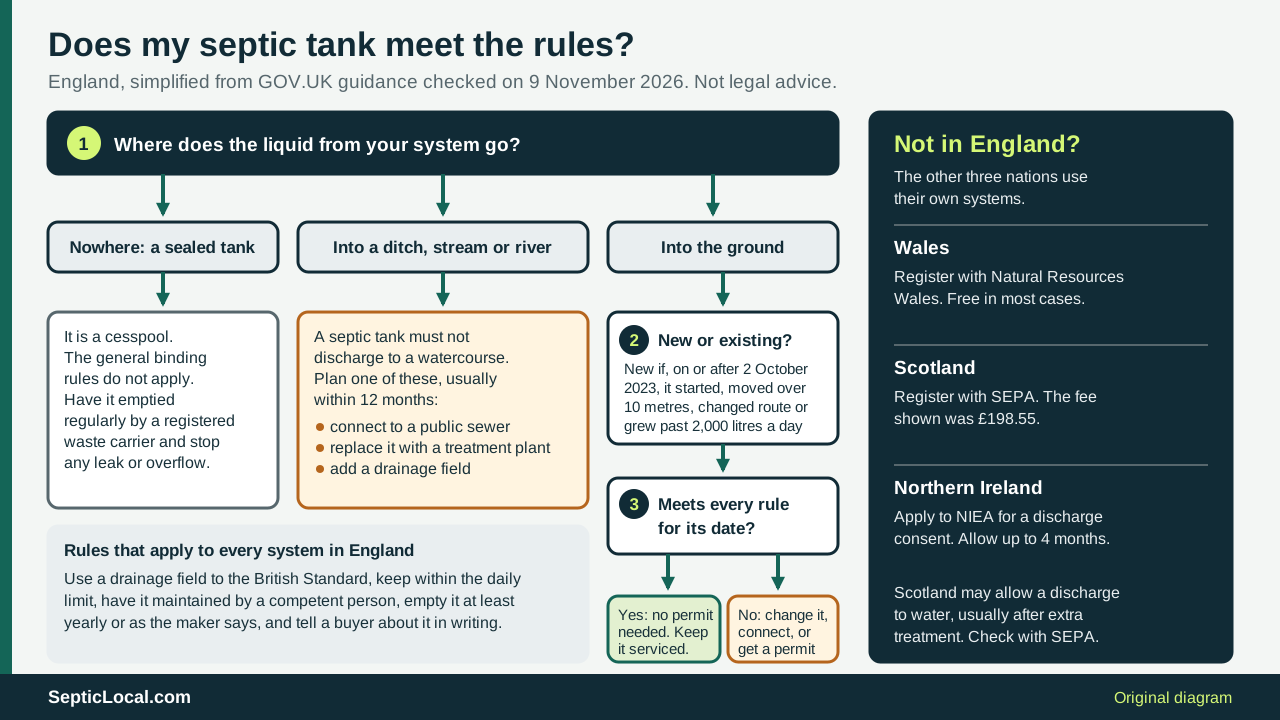
What are the septic tank regulations in the UK?
There is no single UK rulebook. Each nation has its own regulator and process, and England’s general binding rules do not apply elsewhere.
GOV.UK’s guidance for owners, “Septic tanks and sewage treatment plants: what you need to do”, covers England only and sends readers elsewhere for the rest of the UK. In England the conditions sit in the Environmental Permitting (England and Wales) Regulations 2016, as amended in 2023, and GOV.UK calls them the general binding rules. If a system meets every rule that applies to it, no permit is needed. Wales registers small systems through Natural Resources Wales (NRW), Scotland through the Scottish Environment Protection Agency (SEPA), and Northern Ireland issues consents through the Northern Ireland Environment Agency (NIEA), part of DAERA.
Our guide to how a septic tank works has a one-table summary of the four nations. This guide goes further, by situation: what to check, what to apply for and who to ask.
What did the 2020 septic tank rules change?
England set 1 January 2020 as the deadline for septic tanks draining straight into rivers or streams to be upgraded. That duty still applies.
The version of GOV.UK’s surface water guidance archived by The National Archives in June 2019 (last updated 5 July 2018) said that a septic tank discharging directly to surface water needed its treatment system replaced or upgraded by 1 January 2020. It added that if such a property was sold before then, the two parties should settle between them who would pay, as part of the sale terms. This is where the many “2020 septic tank regulations” articles come from.
The deadline has gone from the current guidance, but the rule has not. GOV.UK’s page history shows that on 25 October 2019 it changed the wording to say owners must act as soon as possible. It now says that if a septic tank discharges directly to a watercourse you must act “as soon as possible” and have plans in place to do the work in a reasonable time, which it says is usually 12 months. A tank that was never upgraded is not let off because 2020 has passed. The 2020 date was about England; it never applied to the other three nations.
Does my system count as a new or an existing discharge?
England counts a discharge as new if it started, moved over 10 metres, changed route or passed the daily limit from 2 October 2023.
GOV.UK uses the word discharge for the liquid your system releases. The date it started, and anything changed since, decides which rules apply. GOV.UK’s ground discharge guidance says a discharge that began before 2015 keeps its category even if the treatment system has been replaced, as long as the other points still apply. Whenever you change a system, GOV.UK asks you to check again whether it now counts as new. The table is built from the wording on GOV.UK’s ground and surface water pages.
| Your discharge | What GOV.UK calls it | Rules to meet |
|---|---|---|
| Running before 1 January 2015, not moved more than 10 metres, not switched between ground and water, not grown past the limit | Existing, started before 2015 | The rules that apply to all discharges |
| Started, moved more than 10 metres, switched route or grew past the limit between 1 January 2015 and 1 October 2023 | Existing, started from 2015 | All discharges, plus the 2015 rules: no public foul sewer within reach, building regulations approval, distance from protected sites |
| Started, planned, moved more than 10 metres, switched route or grew past the limit on or after 2 October 2023 | New | All of the above, plus: connect to a sewer if the Environment Agency thinks it reasonable, do not share an outlet above the limit, and be 50 metres or more from any other discharge under the rules |
The limit is 2 cubic metres (2,000 litres) a day for a discharge to ground, or 5 cubic metres (5,000 litres) a day to surface water. For households, GOV.UK points to its daily discharge calculator; for businesses or holiday lets, to British Water’s Flows and Loads guidance. If you are buying, GOV.UK says to check when the system was installed so you know whether it counts as new or existing.
Can a septic tank drain to a ditch, stream or river?
Not in England, Wales or Northern Ireland. Scotland may accept a discharge to water in some cases, usually with extra treatment after the tank.
In England, GOV.UK says septic tank effluent must not go into a watercourse. The options GOV.UK gives are a public foul sewer connection, swapping the septic tank for a small sewage treatment plant, or adding a drainage field so the liquid soaks into the ground instead. A treatment plant that discharges to water has its own conditions. For discharges started from 2015 they include that the water must flow all year: a ditch or a stream that dries up in summer cannot meet the rules. Where several neighbouring homes need to upgrade, GOV.UK says the sewerage company may have a legal duty to provide a sewer, known as first time sewerage.
In Wales, NRW says a discharge to surface water must be from a package treatment plant. In Northern Ireland, DAERA’s domestic consent FAQs say plainly that septic tanks cannot discharge into a waterway. In Scotland, SEPA asks you to investigate a soakaway first. If water is the only option, the watercourse must have enough flow, the outlet must not be upstream of and within 1.5 kilometres of a drinking water supply, and secondary treatment will normally be needed unless the flow is high.
To replace a tank with a plant, see sewage treatment plant installation. To add or rebuild a field, see drainage fields. Our guide to repair or replacement helps if the tank itself is also in poor condition.
If the house is being sold, GOV.UK does not decide who pays. It leaves it to the two sides, saying responsibility for the upgrade should be agreed as one of the conditions of the sale. That makes it a negotiating point, so it pays to find out early. A buyer’s survey should establish where the liquid actually goes; a seller who already knows the system drains to a ditch can get quotes before the sale and avoid a late renegotiation.
What are the rules for drainage fields and soakaways?
In England, septic tank liquid must reach the ground through a drainage field built to BS 6297:2007, not a well, borehole or rainwater soakaway.
GOV.UK says a rainwater soakaway installed after December 2007 cannot meet the general binding rules, and nor can a well or borehole used to discharge waste water. The owner must either upgrade to a drainage field that meets the British Standard or connect to a sewer where that is reasonable. Drainage mounds can meet the rules if they are outside floodplains and built to BS 6297:2007. Since 23 July 2026 the same applies to ground engineered so that water percolates through it more slowly, as long as it is not in a floodplain, reaches a percolation value (Vp) of at least 15 and follows the rest of that standard. Each part must meet the standard that applied when it went in; GOV.UK says systems installed before 1983 need not, because no British Standard existed then.
Scotland sets its own siting tests. SEPA says the highest winter water table should be more than a metre below the base of a soakaway, that it should normally be at least 10 metres from field drains, watercourses, lochs and the sea, and that a percolation test is needed. A soakaway also needs a building warrant from the local council. The drainage fields page lists businesses that test, design and replace them.
Do I need a permit, or is registration enough?
Most homes need no permit. England relies on meeting the general binding rules, Wales and Scotland on registration, and Northern Ireland on a consent.
In England, a permit is only for systems that cannot meet the rules, and GOV.UK says the Environment Agency will not give one if you could meet them, or if connecting to the public sewer is reasonable. There are standard rules permits for lower-risk discharges and bespoke permits, which take longer and can cost more. GOV.UK is blunt: you are breaking the law if you operate without a permit when you need one.
In Wales, NRW says most septic tanks and small package plants need only a one-off, free registration as exempt. Its permit for domestic sewage costs far more. The application fees NRW showed were £3,691 for a discharge of less than 5,000 litres a day to ground and £3,959 for the same to surface water, with £2,990 more where a habitats assessment is needed. In Scotland, SEPA charges £198.55 to register a small discharge, and a permit is needed instead in the catchments of Loch Leven, the Lunan Lochs and Loch Flemington, for a discharge straight into a freshwater loch or pond, or for more than 10 homes. In Northern Ireland every private system needs a consent; DAERA publishes the fees separately.
What applies if I install, replace or move a system?
Check first whether you can join a public sewer. If not, a new system needs building regulations approval and must meet the new discharge rules.
In England, GOV.UK says the general binding rules cannot be met by a single home whose boundary is within 30 metres of a public foul sewer, for discharges started from 2015. For a development, multiply 30 metres by the number of homes. For a new discharge the Environment Agency weighs distance, the cost of connecting against the cost of a treatment system, obstacles such as a large road, and any environmental benefit. GOV.UK requires building regulations approval to install any new septic tank or treatment plant, and planning permission may also apply. GOV.UK also asks you to check with the installer that anything installed since 1 February 2006 is sized to British Water’s Flows and Loads guidance. Moving the outlet more than 10 metres, or switching between ground and water, makes it a new discharge.
Wales uses the same 30 metre test. NRW adds that if a water company refuses a connection you must appeal to Ofwat before NRW will consider a permit, and that lack of capacity in the sewer is not a valid reason to refuse. In Scotland, SEPA uses 30 metres times the number of homes, will not authorise new untreated discharges, and asks you to contact Scottish Water first. Its change guidance says that upgrading from a septic tank to a package treatment plant, or replacing a system with one that treats to the same level, needs no new registration, but moving the outlet more than 10 metres or changing where it discharges does. In Northern Ireland, DAERA’s FAQs say no system should be installed before the consent is in place, and a new tank or plant needs its CE certificate.
For quotes, see septic tank installation or treatment plant installation, and ask each business which approvals it will apply for.
What if I am near a protected site or a water supply?
Extra limits apply. Near drinking water supplies or wildlife sites, a system may need a permit instead of meeting the general rules or registering.
In England, a drainage field in a groundwater source protection zone 1 needs a permit (zone 1c excepted). GOV.UK says that zone can include any area within 50 metres of a private water supply, so it suggests asking neighbours whether they have a spring, well or borehole. For discharges started from 2015, a discharge to ground cannot meet the rules in ancient woodland or within 50 metres of a special area of conservation, special protection area, Ramsar site or biological SSSI. For surface water the distance is 500 metres, and the list adds bathing waters, shellfish waters and freshwater pearl mussel populations, with 200 metres for aquatic local nature reserves and 50 metres for chalk rivers. GOV.UK explains how to check these on Defra’s Magic map.
In Wales, NRW’s free registration has similar distances, and offers an online map to check eligibility. Systems already running before 6 April 2010 have some relief: a package plant draining to a watercourse can still register free near sensitive sites. In Scotland, SEPA asks for a soakaway to be at least 50 metres from any spring, well or borehole used for drinking water where it serves one to three homes, and 250 metres where it serves four to ten.
What must I tell a buyer when I sell?
In England, a seller must give the buyer written notice of the sewage discharge, with details of the system and how it is maintained.
GOV.UK lists what to include: a description of both the treatment system and the drainage, the location of its main parts and of the discharge point, any changes made, maintenance instructions with the manual if you have one, and any maintenance records you hold. In Wales, NRW says maintenance records must be kept for 5 years, partly in case a prospective buyer asks for them. In Northern Ireland, DAERA’s FAQs deal with the case where a solicitor asks for consent before completion: check the online Domestic Consent Public Register first, and apply online if none can be found. A transfer of ownership form exists for consents already in place. SEPA’s pages say a change of name or address on a registration needs no new application.
Buyers will find the checklist and survey advice in our guide to buying a house with a septic tank. A septic tank survey is the usual way to find out where the liquid goes before exchange.
Where to register or apply in each nation
Use the regulator’s online service: NRW in Wales, SEPA in Scotland and DAERA in Northern Ireland. England has no registration step for systems that meet the rules.
| Nation | What a household applies for | How | Fee shown |
|---|---|---|---|
| England | Nothing if the system meets every rule that applies; an environmental permit if it cannot | Check the rules on GOV.UK; the Environment Agency gives pre-application advice on permits | None given on the owner pages we checked |
| Wales | Registration as an exempt discharge; a permit if not eligible | NRW online registration, or permit form B6.5 for smaller discharges | Registration free in most cases; permits from £3,691 |
| Scotland | Registration for up to 10 homes; a permit in some places | SEPA online service (existing discharges from 9 homes or fewer), or a form by email | £198.55 to register (SEPA’s page says nothing about VAT) |
| Northern Ireland | A discharge consent from NIEA | DAERA online application with a Government Gateway account, plus two maps | Published in DAERA’s fees scheme |
Scotland: the November 2025 change
SEPA moved septic tank registrations to a new authorisation system on 1 November 2025. Older registrations transferred automatically, and newer ones carry standard conditions.
SEPA’s pages describe the new authorisations as EASR authorisations. A registration under the old system (CAR) that was in place on 31 October 2025 became one of these automatically on 1 November 2025, so owners did not need to reapply. Registrations granted from 1 November 2025 are subject to standard conditions, published on SEPA’s discharge of sewage effluent page. If you are not sure whether your system is registered, SEPA has a registration check, and registering twice will not be refunded. SEPA treats a system less than 2 years old as a new discharge, which is a different test from England’s.
Northern Ireland: inspection and timing
Allow up to four months. NIEA may inspect the system, including a dye test, and asks for repairs before it issues the consent.
DAERA says the Water (Northern Ireland) Order 1999 gives four months to decide an application. Its FAQs say all existing systems are inspected, and an older house with no consent can apply retrospectively. A domestic consent covers one house with one system. A refusal can be appealed to the Water Appeals Commission within 28 days. nidirect says NI Water offers households one free desludge every 12 months if the property and tank meet its access and safety conditions; a second one in the same year is charged.
What are the rules for cesspits?
England’s general binding rules do not apply to a cesspit, but it must be emptied regularly by a registered waste carrier and never leak.
GOV.UK uses the formal name, cesspool. It gives once a month as an example of regular emptying and says no permit is needed unless the Environment Agency says so. The Environment Agency or the local council can make you repair or replace a cesspool in poor condition, and you are breaking the law if it causes pollution. A new one needs planning permission and building regulations approval, and must hold at least 18,000 litres for 2 users, plus 6,800 litres for each extra user. GOV.UK adds that if a system releases anything into the ground or water, it is not a cesspool, whatever it is called locally. Our cesspit emptying page lists businesses that empty them, and the tank types guide helps you tell the systems apart.
Who is responsible for a shared septic tank?
Everyone it serves. In England, owners of properties sharing a system are jointly responsible, and a tenant can be responsible if the tenancy says so.
GOV.UK names the person responsible the operator: the owner of the property using the system, every property sharing it jointly, or anyone with an agreement, such as a tenancy, that makes them responsible. SEPA says maintenance responsibilities on shared systems in Scotland are shared among the connected properties. In Northern Ireland, two homes sharing one tank cannot use a domestic consent; DAERA says a trade consent is needed instead. A written agreement between neighbours on emptying, repairs and access saves arguments later.
What happens if my system does not meet the rules?
In England you must join a sewer where reasonable, change the system, or get a permit. Causing pollution can be an offence.
GOV.UK says that if a discharge causes pollution you may be committing an offence, that the Environment Agency will first give advice to help fix the problem, and that it may take enforcement action if the pollution continues. It also lists faults that call for repair or replacement, including leaks, cracks, blocked pipes, water pooling round the drainage point, sewage smells and failed motors, pumps or electrics. Some websites quote large fines for septic tank owners. None of the official owner pages we checked gives a fine for a household system, so we do not repeat one.
Checking your own system, step by step
Work from the paperwork outwards: identify the system, find where the liquid goes, date it, then compare it with your nation’s rules and get a professional check.
- Gather the paperwork. Installation records, the building control approval, any registration, consent or permit, emptying invoices and survey reports.
- Name the system. A cesspit has no outlet, a standard septic tank works without power, and a treatment plant usually runs an air pump or has a control panel. GOV.UK suggests asking a local installation or maintenance company if you are unsure.
- Find where the liquid goes. Ground through a drainage field, a ditch or stream, or nowhere. This is the question most often answered wrongly, and a survey settles it.
- Date it. In England, note whether it started, moved or changed before 2015, between 2015 and 1 October 2023, or later.
- Check the location. Distance to the nearest public sewer, any private water supply nearby, and any protected site on Magic map (England) or NRW’s map (Wales).
- Ask a competent person to confirm. GOV.UK points to British Water’s list of accredited service engineers, and says other competent engineers may also exist.
| What you find | Likely next step | Where to start |
|---|---|---|
| You do not know what the system is or where it drains | A survey before you buy, sell or change anything | Septic tank surveys |
| A septic tank drains to a ditch or stream | A treatment plant, a drainage field or a sewer connection | Treatment plant installation |
| Water pools over the drainage field | An assessment of the field, and a percolation test if it is rebuilt | Drainage fields |
| The tank leaks or is cracked | Repair or replacement | Septic tank repairs |
| It has not been emptied in over a year | An empty by a registered waste carrier | Septic tank emptying |
| It is a sealed cesspit | Regular emptying and a check for leaks | Cesspit emptying |
What does it cost to put a system right?
It depends on the fix. A survey costs far less than a new treatment plant or drainage field, and official fees vary by nation.
The only fixed figures are the regulators’ own: SEPA’s £198.55 registration in Scotland, NRW’s free registration or permit fees from £3,691 in Wales, and DAERA’s published consent fees in Northern Ireland. The cost of the work itself depends on what the survey finds, the ground conditions, access for a digger and a tanker, how far away a sewer is, and whether building regulations or planning approval are needed. GOV.UK notes that bespoke permits can cost more than standard ones because the site is assessed by hand. For survey prices, see septic tank survey costs; for the rest, get written quotes from more than one business.
Questions to ask an installer or surveyor
Ask which nation’s rules they are working to, where the liquid goes, which approvals they will obtain, and what records you will receive.
- Does my system count as new or existing, and why?
- Where exactly does the liquid go, and how did you confirm it?
- Is there a public sewer within 30 metres of the boundary, or a water supply or protected site nearby?
- Will you apply for building regulations approval, and is planning permission needed?
- Does the new tank, plant or drainage field meet the current British Standard, and will I get the certificate?
- In Wales, Scotland or Northern Ireland: will you handle the registration or consent application, or should I?
- What maintenance and emptying will it need, and will you give me a written record I can pass to a buyer?
Common questions
Has England changed its septic tank rules since 2020?
Yes. GOV.UK added the new discharge rules on 2 October 2023 and the engineered ground option for drainage fields on 23 July 2026.
The page histories on GOV.UK also show an update on 25 August 2021, when the definition of a new discharge was widened to cover volume increases above the limit. We found no change dated 2022 on either page.
Is a septic tank installed before 1983 still allowed?
It can be. GOV.UK says systems installed before 1983 need not meet a British Standard, because none existed, but every other rule still applies.
An old tank that drains to a ditch or stream, leaks or is overloaded still has to be put right. Age alone is not a breach.
Do the rules cover holiday lets and small businesses?
Yes, if the sewage is domestic in nature, such as toilets, showers and kitchens. Other waste water needs a permit in England.
GOV.UK gives pubs, hotels and offices as examples of businesses whose sewage can be domestic in nature. For commercial premises and holiday accommodation, it asks owners to work out the daily volume with British Water’s Flows and Loads guidance, adding all sources together.
Sources and further reading
All opened on 9 November 2026. Regulators revise these pages, so read the current version for your nation before you act.
- GOV.UK: Septic tanks and sewage treatment plants, what you need to do (England; updated 29 January 2025)
- GOV.UK: Rules for discharges to the ground (England; updated 23 July 2026)
- GOV.UK: Rules for discharges to surface water (England; updated 2 October 2023)
- GOV.UK: Small sewage discharges in England, the full general binding rules
- The National Archives: the surface water guidance as it stood in 2019, with the 1 January 2020 deadline
- Natural Resources Wales: Register your septic tank or package treatment plant
- Natural Resources Wales: Apply for a permit to discharge domestic sewage (fees)
- Natural Resources Wales: Private sewage treatment where there is a public sewer
- SEPA: Septic tanks and private sewage treatment systems (Scotland)
- SEPA: Registration guidance, including soakaways and watercourses
- SEPA: Making a change to your registration
- DAERA: Regulating water discharges (Northern Ireland)
- DAERA: Domestic consent FAQs
- nidirect: Septic tanks and NI Water desludging
- HSE: Working in confined spaces
Find help with the rules for your system
Septic Local is a directory of independent businesses: we do not survey, install or certify systems, and we cannot say whether yours meets the rules. Search the listed contractors or browse locations, then confirm the business works in your postcode and handles your kind of system. Start with a survey if you are unsure what you have, or with installation if you already know it needs replacing. We may not find a business for every area, and this is not an emergency service.
Ready to book? Get a quote
Tell us about the job and we will pass it to one listed contractor that covers your postcode and does this work. It is free, and you agree the price and visit directly with the business. Prefer to choose yourself? Call any business on this page.